
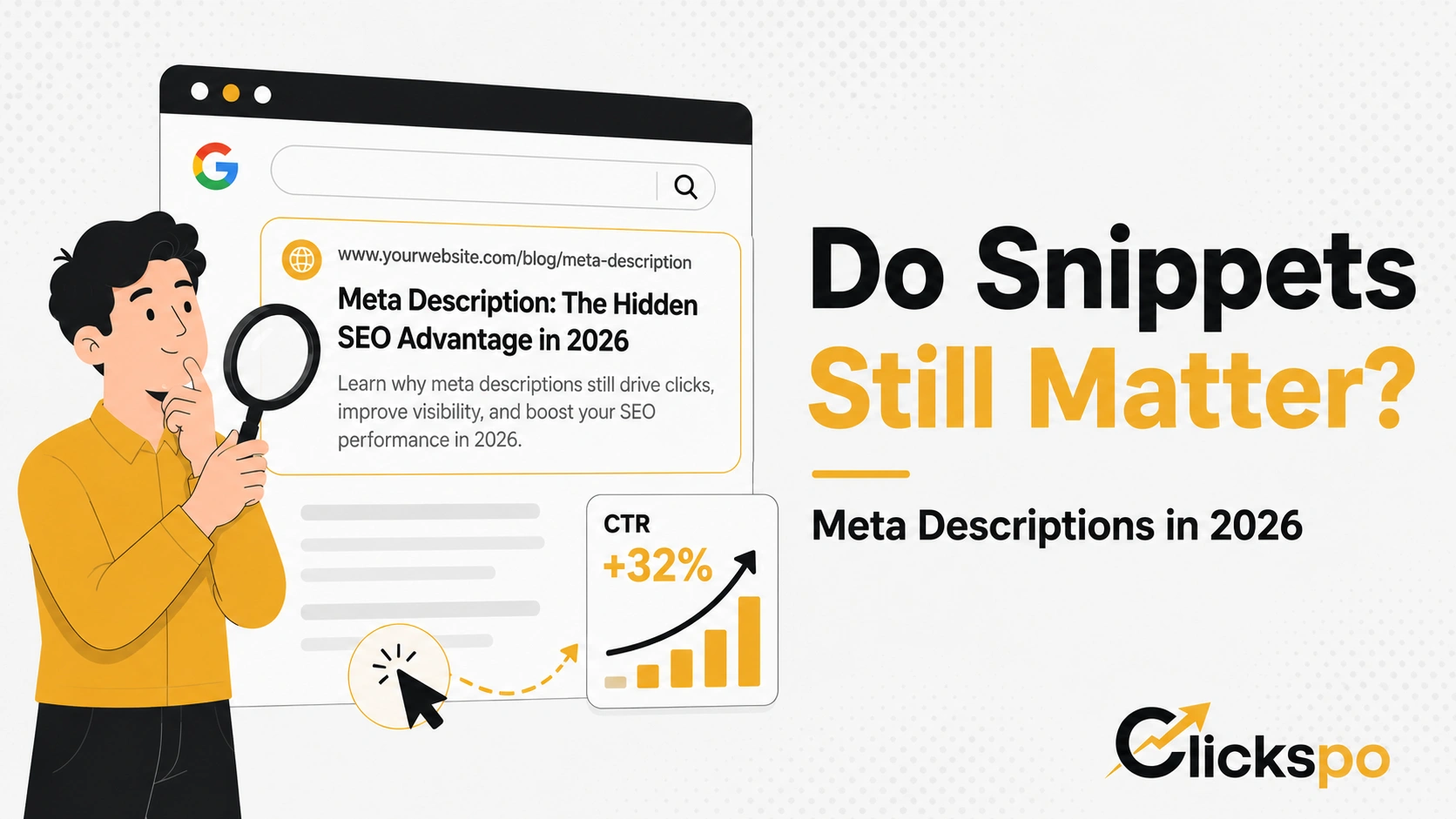
Every few years, someone in the SEO industry declares that meta descriptions no longer matter. Our team at Clickspo has heard this argument more times than we can count, and every time we dig into the data, the answer is the same: they still matter, just not in the way most people think. If you are managing a website in Hong Kong and wondering whether you should still spend time crafting your meta descriptions, this article gives you a clear, experience-based answer.
What a Meta Description Actually Does
Before deciding whether something is important, you need to understand what it is supposed to do. A meta description is the short snippet of text that appears beneath your page title in Google search results. It does not directly influence your keyword rankings. Google confirmed this years ago and has never reversed that position.
What a meta description does influence is your click-through rate, which is the percentage of people who see your result and actually click on it. Think of it as the short pitch your page makes to a searcher before they commit to visiting. A well written description tells the reader exactly what they will get, matches the intent behind their query, and gives them a reason to choose your page over the nine others on the screen.
Our keyword research using Ahrefs shows that “meta description” receives around 90 searches per month in Hong Kong alone, with a keyword difficulty score of 77, which means established sites are actively competing for this traffic. The fact that competition exists confirms that practitioners still treat this topic as commercially relevant.
Does Google Always Use Your Meta Description?
This is where the topic gets genuinely interesting and where a lot of website owners feel frustrated. Google rewrites meta descriptions more often than most people realise. Studies from various SEO toolsets have consistently found that Google ignores the provided meta description and generates its own snippet roughly 60 to 70 percent of the time.
Why does Google rewrite your description? The main reasons include:
- Your description does not match the search query closely enough
- Your description is too short, too long, or stuffed with keywords
- Google believes a passage from the page body better answers the user’s specific question
- The page has very little content for Google to reference, so it pulls what it can
This might sound like a reason to stop writing meta descriptions altogether. It is not. When Google does use your description, it is because you have written something that serves the searcher well. That is exactly the scenario where a compelling description drives more clicks. For the queries where your brand matters most, where the user is comparing you against competitors, that is when your crafted copy does its job.
The Click-Through Rate Connection
Google does not use click-through rate as a direct ranking signal in the traditional sense. However, if significantly more people click your result and stay on the page, that behaviour sends positive engagement signals. The more accurately your meta description sets expectations, the lower your bounce rate will tend to be, because visitors arrive knowing what they are getting.
The connection between meta descriptions and click-through rate is well established in industry practice. Here is how the quality of a description affects user behaviour at each stage:
| Description Quality | Likely CTR Impact | Bounce Rate Risk |
|---|---|---|
| Vague or generic copy | Lower CTR | Higher bounce rate if expectations are unmet |
| Keyword stuffed, unnatural | Lower CTR | High abandonment if page does not match |
| Clear, benefit-driven, accurate | Higher CTR | Lower bounce rate |
| Tailored to query intent | Highest CTR | Lowest bounce rate |
This matters significantly for competitive local search. If you are running local SEO in Hong Kong, your meta descriptions are part of how your business presents itself before a user even reaches your site. Getting them right is not a small detail.
Meta Description Length: What Still Works in 2026
Google generally truncates snippets at around 155 to 160 characters on desktop and slightly shorter on mobile. Writing within that range has been the standard recommendation for years, and it remains valid. The principle is straightforward: say what the page delivers, include the primary keyword naturally, and stop before you get cut off mid-sentence.
What has changed in 2026 is the increased presence of AI-generated search features. Google’s AI Overviews, which appear above the traditional results for many informational queries, mean that some searches now result in fewer clicks to organic results overall. In this environment, the pages that do earn clicks need to work harder for them. A weak meta description in a more competitive click environment is a bigger problem than it was three years ago.
Our team explores AI search optimisation as a growing practice precisely because these shifts in the search landscape affect how users interact with results pages. A well crafted meta description remains one of the simplest on-page levers available to improve that interaction.
How to Write a Meta Description That Actually Gets Clicked
The mechanics of a good meta description have not changed, but the expectations from searchers have risen. Here is the framework we apply when writing descriptions for client pages:
Lead with the user’s problem or outcome. The reader is scanning quickly. The first few words need to signal that your page is relevant. Starting with what the user gets, rather than what your company does, almost always performs better.
Include the target keyword naturally. Google bolds keywords in the snippet that match the user’s search. This visual emphasis draws attention. Force the keyword awkwardly and it reads as spam. Use it where it belongs grammatically.
Add a specific reason to click. A concrete detail outperforms a generic promise. “Covers application fees, timeline, and required documents” is more clickable than “Learn everything about the process.”
Keep it under 155 characters. Write the most important information first. If Google truncates the end of your description, the essential message has already landed.
Match the page intent precisely. If the page sells a service, the description should feel like a service page. If it answers a question, it should feel informative. A technical SEO audit page describing in-depth site analysis will naturally have a different description tone than a blog post explaining SEO basics.
When Meta Descriptions Matter Most for Hong Kong Businesses
Not every page on your site deserves equal effort on the meta description. Here is how we prioritise for the clients we work with across law firms, dental clinics, physiotherapy practices, gyms, and other sectors:
High priority pages:
- Your homepage and core service pages, where you want to control brand perception in search results
- Pages targeting high competition keywords where every incremental CTR gain is valuable
- Pages where Google historically rewrites your snippet, which means your page copy needs to be cleaner and more relevant so Google pulls better material
Lower priority pages:
- Deep blog posts targeting informational queries where Google will pull the most relevant passage anyway
- Internal utility pages not intended for organic traffic
- Pages that already rank in position one with strong CTR data
If you are working with an agency to manage your SEO strategy in Hong Kong, your account team should be reviewing meta descriptions as part of any content or keyword research workflow, not as a standalone task done once and forgotten.
Practical Mistakes We See Most Often
After reviewing hundreds of pages across client accounts, these are the most common meta description failures we encounter:
- Leaving it blank. WordPress and many CMS platforms will auto-generate a snippet by pulling the first paragraph of the page. This is almost never the best option.
- Duplicating descriptions across pages. If multiple pages share the same description, you are giving Google less context and giving searchers no reason to prefer one result over another.
- Writing for search engines instead of people. Descriptions crammed with keywords read as spam. They underperform descriptions written for the person scanning results.
- Ignoring mobile truncation. Mobile devices display even shorter snippets. Front-load your message.
- Not updating after a page refresh. If you update a page’s content and angles, the description should reflect the new direction.
FAQs About Meta Descriptions
Does the meta description affect my Google ranking?
Not directly. Google has confirmed that meta descriptions are not a ranking factor. They do influence your click-through rate, which affects how much traffic a given ranking position actually delivers to your site.
How long should a meta description be in 2026?
Keep it between 140 and 160 characters. This stays within the display window for most desktop searches and ensures your key message is visible before any truncation occurs.
What happens if I do not write a meta description?
Google will auto-generate one by pulling text from your page. This can work adequately for some pages, but for your most important service and landing pages, the automatically generated snippet is rarely as compelling as a purposefully crafted one.
Should I write separate meta descriptions for Traditional Chinese and English pages?
Yes, always. A direct translation rarely captures the same intent or keyword context. Your Chinese audience may be searching with different phrases, and the description needs to reflect that. At Clickspo, we treat each language version as a separate optimisation task.
Can AI tools write meta descriptions for me?
AI tools can produce first drafts quickly and at scale, which is useful for large sites with hundreds of pages. However, AI generated descriptions often default to generic language. We recommend using AI output as a starting point and editing each description to include specific details, the natural keyword, and a clear reason to click.
Does Google ever use social media preview as a replacement for meta descriptions?
Not in Google Search. The Open Graph description tag is used by social platforms like Facebook and LinkedIn to generate previews when a page is shared. These are separate tags. Your meta description handles search; your Open Graph tags handle social sharing. Both are worth setting correctly.