
What Is Search Intent and Why Does It Affect Keyword Choice?
Most businesses approach keyword research the same way: find a term with decent search volume, write a page around it, and wait. The problem is that volume alone tells you almost nothing about whether a keyword will actually convert or rank. Search intent is the missing piece. It tells you why someone is searching, not just what they typed. Get the intent wrong and Google will rank a competitor who answered the question better, regardless of how well optimised your page is technically.
Why Google Prioritises Intent Over Keywords
Google has spent years moving away from exact keyword matching toward understanding what a user actually wants to accomplish. When you type a query into Google, the algorithm evaluates the dominant intent behind it and surfaces content formats that historically satisfy that intent.
This is why searching “best running shoes” returns listicles and review roundups, not brand homepages. And why searching “buy Nike Air Max” returns product and category pages, not blog posts. Google is pattern matching your query against what users have found satisfying for similar searches in the past.
For SEO, this has a direct consequence: if you publish the wrong content format for a given keyword, you are competing against the wrong type of pages. A service page competing against informational guides will almost never outrank them, even with superior backlinks. Matching intent is a prerequisite, not a ranking boost.
This is also why keyword research cannot be separated from content strategy. The keyword you choose determines the intent you are targeting, which determines the content format you need to produce.
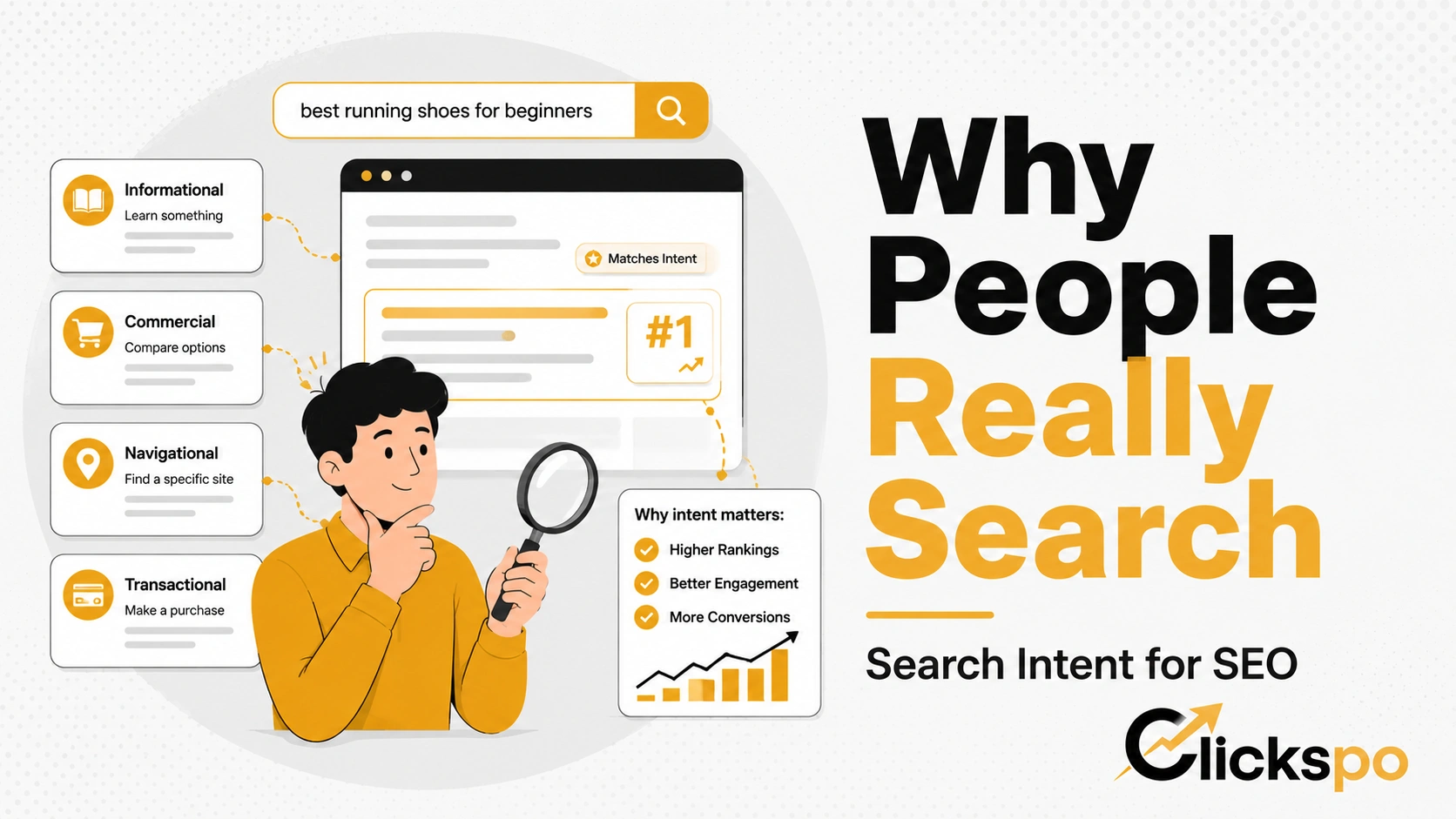
The Four Types of Search Intent
Understanding intent starts with recognising the four categories that cover the vast majority of searches.
Informational Intent
The user wants to learn something. They are not ready to buy and are often not even sure what solution they need yet.
Examples:
- “what is local SEO”
- “how does Google rank websites”
- “signs your website has an SEO problem”
Content that performs here: blog posts, guides, explainer articles, FAQs. If you run a service business, this is where you build awareness and trust with potential clients who are at the top of the funnel.
Navigational Intent
The user already knows where they want to go. They are using Google as a shortcut to a specific website or brand.
Examples:
- “Clickspo SEO Hong Kong”
- “Ahrefs login”
- “Google Search Console”
You will almost always rank for your own branded queries here. Targeting someone else’s navigational keywords is rarely a productive use of SEO effort.
Commercial Investigation Intent
The user is actively comparing options before making a decision. They know the category of solution they want but have not committed to a specific provider or product.
Examples:
- “SEO vs Google Ads for small business”
- “best SEO agency Hong Kong”
- “Wix SEO vs WordPress SEO”
This intent sits between informational and transactional. Comparison articles, case studies, and reviews perform well. For agencies and service providers, this is one of the highest value intent types to target because users are close to a decision. Our article on SEO vs Google Ads is a good example of content built specifically for this stage.
Transactional Intent
The user is ready to act. They want to buy, book, sign up, or contact someone.
Examples:
- “hire SEO agency Hong Kong”
- “dental clinic SEO pricing”
- “book physiotherapy Hong Kong”
Content that performs here: service pages, landing pages, product pages with clear calls to action. If you are running a local SEO campaign for a clinic or professional services firm, these are the keywords that drive actual enquiries.
How to Match Keywords to the Right Intent
| Intent Type | What the User Wants | Best Content Format | Funnel Stage |
|---|---|---|---|
| Informational | Learn or understand something | Blog post, guide, FAQ | Awareness |
| Navigational | Find a specific website or brand | Brand page, homepage | Any |
| Commercial Investigation | Compare options before deciding | Comparison article, case study | Consideration |
| Transactional | Take an action or make a purchase | Service page, landing page | Decision |
When you are building out a keyword list, assign an intent label to each keyword before deciding what page should target it. This prevents two common mistakes: publishing a sales page when the keyword calls for an educational guide, and writing an informational article when the keyword signals the user is ready to convert.
Real Consequences of Ignoring Search Intent
Getting intent wrong does not just limit your rankings. It creates a mismatch between what users expect and what they find on your page, which damages engagement metrics. Bounce rates climb, time on site drops, and Google interprets this as a quality signal against your page.
Consider a physiotherapy clinic targeting the keyword “what causes lower back pain.” If the clinic’s service page shows up for this query and leads with pricing or a booking form, the user will leave immediately. They wanted an explanation, not a sales pitch. The page gets penalised over time because it fails to serve the intent.
The right move is to publish an informational article answering the question, build trust with the reader, and include a contextual mention of the clinic’s physiotherapy services in Hong Kong as a natural next step. That is how intent matching converts at every stage of the funnel, not just the bottom.
Intent Matching in Competitive Markets
In markets where multiple businesses target the same keywords, intent alignment becomes a decisive competitive advantage. Two businesses can both target “SEO for law firms Hong Kong” but if one publishes a comprehensive guide and the other publishes a thin service page, the guide will almost always rank higher because Google’s intent signal for that keyword leans informational.
This is particularly relevant for professional services. Law firms, dental clinics, and specialist consultancies often underinvest in informational content and over-rely on service pages. The result is a website that tries to rank for dozens of keywords but satisfies the intent of almost none of them.
A structured content approach, where informational articles link through to relevant service pages, is the most reliable way to capture searches across all intent types simultaneously. If you are reviewing your SEO strategy for 2026, intent mapping should be one of the first exercises you run across your existing content.
How to Audit Your Existing Content for Intent Alignment
Before creating new content, it is worth checking whether your current pages are already misaligned. Here is a practical process:
- List your top 20 to 30 target keywords
- Search each keyword in an incognito browser and note the type of content Google surfaces on page one (blog posts, product pages, service pages, videos, etc.)
- Compare that to the page you are currently using to target that keyword
- Where there is a mismatch, either rework the existing page or create a new page in the appropriate format
- Check internal linking to ensure informational content points toward relevant transactional pages
This process often reveals that a business has published good content in the wrong format, or is relying on a service page for a keyword that Google clearly wants answered with an educational article. A technical SEO audit can surface additional issues that compound intent mismatches, including crawl problems and page structure issues that prevent even well-written content from ranking.
Getting intent right is not a one-time exercise. As your target keywords evolve and Google updates its understanding of what users want, content that ranked well can drift out of alignment. Periodic reviews keep your content competitive without requiring constant new production.
FAQs About Search Intent
Can one keyword have multiple types of intent?
Yes, and these are called mixed intent keywords. “SEO pricing” for example could indicate someone comparing options (commercial investigation) or someone ready to get a quote (transactional). When you encounter a mixed intent keyword, look at what Google is actually ranking on page one. The mix of content formats there tells you which intent is dominant and how to weight your own page accordingly.
Does search intent apply to local SEO?
Absolutely. Local searches often carry strong transactional or commercial investigation intent. Someone searching “dentist near me” or “physiotherapy Tsim Sha Tsui” is typically ready to book, which means a well-optimised Google Business Profile and a clear service page will outperform general informational content for those queries.
How does search intent relate to conversion rate?
Intent and conversion rate are directly connected. Transactional keywords attract users who are already close to a decision, so conversion rates are typically higher. Informational keywords attract users who are still learning, so they convert less often directly but contribute to brand awareness and trust over time. The goal is to serve each intent well so users move through the funnel naturally.
Does matching search intent matter for AI search results?
Yes, and increasingly so. AI platforms like ChatGPT and Perplexity also interpret what a user is trying to accomplish when surfacing responses. Content that clearly addresses a specific intent, with structured answers and authoritative context, is more likely to be cited in AI generated responses. Intent clarity is no longer just a Google SEO concern.
Should I create separate pages for each intent type?
Generally yes, if the search volumes justify it. A keyword with informational intent should have a dedicated article. The same topic with transactional intent should have a dedicated service or landing page. Trying to serve both intents on one page almost always results in a page that serves neither particularly well.