
At Clickspo, we spend a significant amount of time inside Ahrefs analysing backlink profiles, SERP compositions, and keyword data across the industries we serve. One question comes up constantly from clients: do backlinks still matter in 2026, and how many do we actually need? The honest answer is more nuanced than most agencies will tell you. Links matter — but the type, the source, and the page they point to matter far more than the number. Here is what our research shows.
Why Backlinks Still Matter in 2026
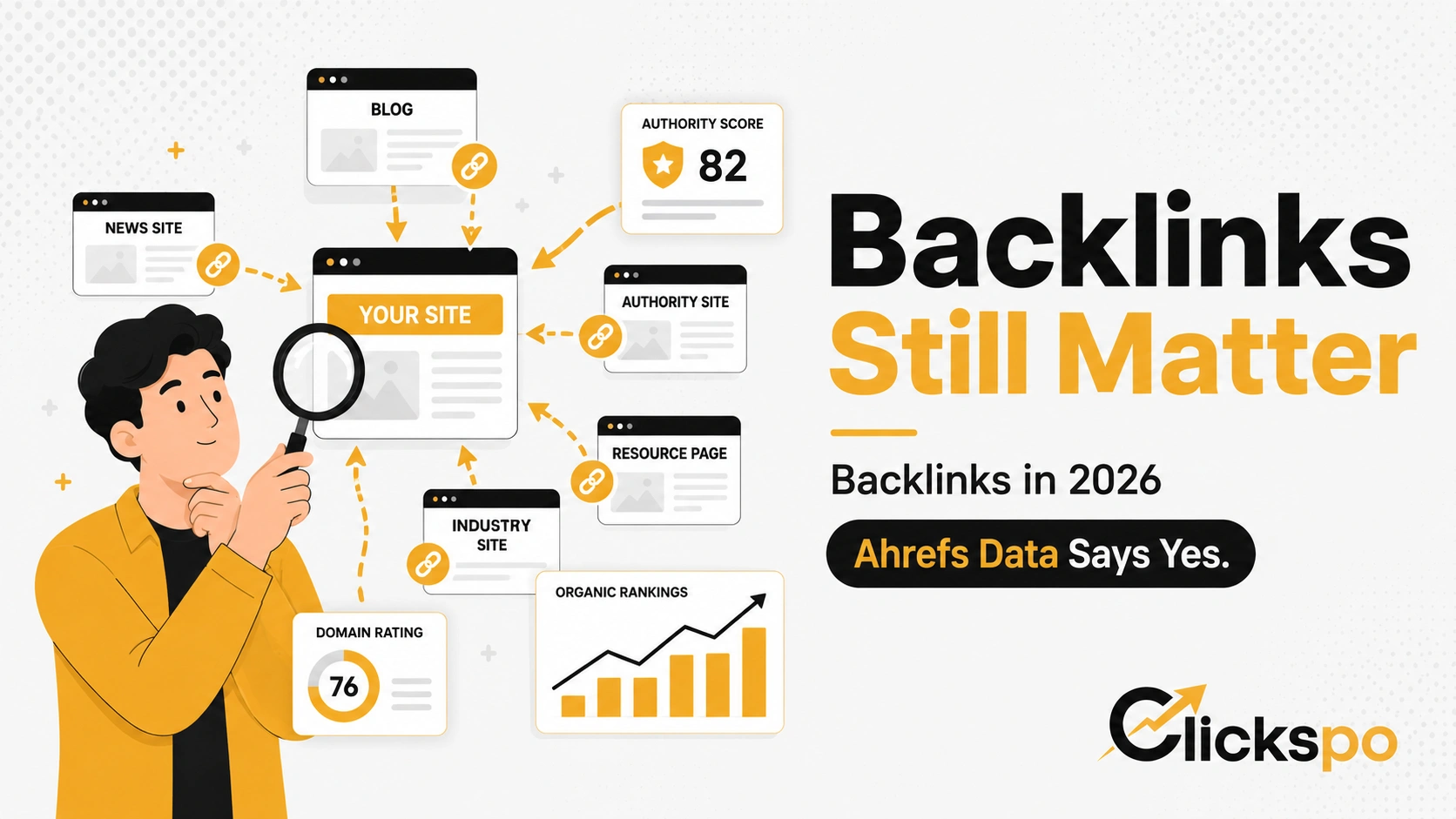
The logic behind backlinks has not changed. When a credible site links to yours, it signals to Google that your content is worth referencing. What has changed is how critically the algorithm evaluates that signal in 2026 — and how easy it has become for Google to identify links that were placed rather than earned.
When we look at the scale of the backlink index in Ahrefs, the numbers are staggering. A single authority domain can accumulate over 296 million backlinks from more than 98,700 live referring domains. The web is not short of links. It is short of links that carry genuine editorial weight — and that is precisely what Google has gotten better at measuring.
In our experience working across legal, dental, fitness, and healthcare sectors in Hong Kong, we consistently see that a handful of well placed, topically relevant links will outperform large volumes of low quality ones. The algorithm in 2026 assesses topical relevance of the linking domain, whether the link appears within editorial content, the actual traffic that linking page receives, and whether the overall backlink profile looks organic or manufactured.
The Keyword Landscape: What We Are Seeing in the Data
Before we talk strategy, it is worth grounding this in what the search data actually shows. When our team pulled Ahrefs keyword metrics across the core backlink related queries in April 2026, here is what came back:
| Keyword | Monthly Volume (US) | Global Volume | Keyword Difficulty | Traffic Potential | Avg CPC |
|---|---|---|---|---|---|
| backlinks | 14,000 | 49,000 | 84 / 100 | 7,500 | $4.50 |
| link building | 12,000 | 38,000 | 84 / 100 | 12,000 | $6.00 |
| how to get backlinks | 1,700 | 3,200 | 42 / 100 | 4,500 | $2.50 |
| backlink audit | 1,400 | 4,900 | 68 / 100 | 2,800 | $4.50 |
| backlink strategy | 1,300 | 2,400 | 8 / 100 | 4,500 | $1.80 |
| dofollow backlinks | 700 | 2,500 | 14 / 100 | 11,000 | $4.00 |
| toxic backlinks | 500 | 1,200 | 30 / 100 | 1,100 | $1.60 |
A few things immediately stand out to us. “Backlinks” and “link building” both sit at a keyword difficulty of 84 — dominated by entrenched SEO publications with years of authority behind them. But “backlink strategy” at KD 8 with a traffic potential of 4,500 visits? That is the kind of gap we look for when planning content for our clients.
We also noticed that every single one of these keywords now triggers an AI Overview in the Google SERP. That is not a coincidence. It means even a well ranking organic result may appear below an AI generated answer — which makes genuine link authority more important than ever, both for traditional ranking and for being cited within those AI responses.
Our data also shows that US search volume for “backlinks” held firm between 13,500 and 15,400 monthly searches from August 2025 through April 2026, with a recent uptick to 15,369 in April. Interest in this topic is not fading.
How Much DR Do You Actually Need? What We Found Across Four Industries
This is the question we get asked more than almost any other. Rather than give a generic answer, we went into Ahrefs and pulled the actual SERP composition for industry relevant keywords across the sectors we work in most. The results challenged several assumptions we expected our clients to have.
Law Firms
When we analysed the SERP for “SEO for law firms”, we found a far more accessible competitive landscape than the legal sector’s reputation for high budgets would suggest:
| Position | Domain Rating | Referring Domains to Page | Est. Monthly Traffic |
|---|---|---|---|
| 1 | 69 | 122 | 3,613 |
| 2 | 85 | 65 | 17,654 |
| 6 | 65 | 26 | 4,881 |
| 8 | 44 | 2 | 6,658 |
| 9 | 81 | 5 | 1,613 |
| 10 | 57 | 3 | 7,461 |
What immediately caught our attention: the page in position 8 generates 6,658 monthly visits from a DR 44 domain with just 2 referring domains pointing at that specific page. Position 10 earns 7,461 monthly visits from a DR 57 domain with 3 page level referring domains. Neither of these are high authority sites by conventional standards.
The broader “law firm SEO” keyword pulls 10,000 monthly US searches at a difficulty score of 25, with a global volume of 14,000. The average CPC of $40 signals just how commercially valuable these leads are — and yet the keyword difficulty suggests this is far from impenetrable for a focused, well structured campaign. If you are a firm considering SEO for law firms in Hong Kong, our data suggests you do not need a DR 90 domain to compete. You need the right page level signals and genuinely useful content.
Dental Clinics
Our keyword pull on the dental space produced one of the most striking findings across all four industries. “SEO for dental clinics” has a keyword difficulty of just 4 in Ahrefs, with a traffic potential of 9,600 monthly visits. The broader “dental SEO” term draws 4,100 monthly US searches at KD 14. These are low competition numbers for what is a commercially significant sector.
When we looked at who is actually ranking, the SERP broke down like this:
| Position | Domain Rating | Referring Domains to Page | Est. Monthly Traffic |
|---|---|---|---|
| 1 | 39 | 14 | 9,757 |
| 2 | 76 | 2 | 6,397 |
| 4 | 58 | 6 | 493 |
| 5 | 73 | 8 | 4,753 |
| 7 | 26 | 2 | 212 |
| 8 | 41 | 2 | 17 |
| 9 | 74 | 9 | 2,572 |
| 10 | 64 | 39 | 602 |
Position 1 is held by a DR 39 domain. Position 7 by DR 26. These are not dominant authority sites — they rank because their page level relevance and topical alignment are solid. When we work with dental clients, we use findings like this to set realistic expectations and build focused link acquisition plans that target page level authority rather than chasing an arbitrary domain rating benchmark. Our SEO service for dental clinics in Hong Kong is built around exactly this kind of data driven approach.
Gyms and Fitness
For the fitness sector, we pulled data on “gym SEO” — a keyword with a global volume of 1,500 and a keyword difficulty score of 1. Near zero difficulty is a direct signal of low competition among pages specifically targeting this query. For gym owners who move quickly with quality content, this is a meaningful opportunity.
The SERP data we found reinforced this:
| Position | Domain Rating | Referring Domains to Page | Est. Monthly Traffic |
|---|---|---|---|
| 2 | 80 | 2 | 609 |
| 4 | 73 | 1 | 408 |
| 5 | 78 | 0 | 205 |
| 6 | 62 | 1 | 171 |
| 7 | 49 | 5 | 266 |
| 8 | 84 | 1 | 133 |
| 10 | 72 | 8 | 362 |
The pattern here is striking. Several high DR domains are ranking with zero to one referring domain at the page level. They are coasting on root domain authority rather than page specific link building. That means a newer site with a well built page and a small number of relevant backlinks can realistically challenge them. In our view, the gym and fitness space in Hong Kong remains one of the most underserved in terms of SEO investment — which means the window to gain ground quickly is still open. We cover the full approach in our SEO guide for gyms in Hong Kong.
Physiotherapy
Of all four sectors we analysed, physiotherapy carries the lowest competition in search. “Physiotherapy SEO” and “physio SEO” both returned a keyword difficulty of 0 in Ahrefs. Global monthly volumes are modest — 450 and 300 respectively — but the traffic potential for the parent topic sits at 700, and at KD 0, a properly structured page with even a small number of relevant links can rank and hold with minimal ongoing effort.
What makes physiotherapy particularly interesting from a link building perspective is how heavily local intent influences the results. The patient searching for a physio is almost always searching within a specific area. That means local SEO signals — Google Business Profile, local citations, and geographically relevant backlinks — carry disproportionate weight compared to raw domain authority. We regularly see DR 20 to 30 sites with strong local signals outranking DR 60 sites that have ignored geographic relevance entirely. Our SEO resource for physiotherapy clinics in Hong Kong goes into this in detail.
What Our Industry Benchmarks Tell Us About DR
Pulling our research across all four sectors, here is how the data compares:
| Industry | Core Keyword | KD Score | DR Range in Top 10 | Page Refdomains Range | Our Key Finding |
|---|---|---|---|---|---|
| Law Firms | law firm SEO | 25 | 44 to 95 | 2 to 122 | Page refdomains drive results more than root DR |
| Dental | SEO for dental clinics | 4 | 26 to 95 | 2 to 39 | DR 26 ranks at position 7 with minimal page links |
| Gyms | gym SEO | 1 | 49 to 84 | 0 to 8 | Most ranking pages have almost no page level links |
| Physiotherapy | physiotherapy SEO | 0 | Lowest barrier of all four sectors | — | Local relevance outweighs domain authority |
The conclusion we draw from this data is consistent across all four sectors: Domain Rating is a useful directional metric, but it does not determine whether a specific page ranks. Page level referring domains, topical relevance, and content quality are the variables that separate results within the same DR band. A DR 40 site with 20 to 30 relevant, editorially placed links will consistently outperform a DR 70 site with none.
This shapes how we approach link building for clients. Rather than setting an arbitrary DR target to chase, we map the actual SERP for the keywords that matter commercially, identify the page level link gap, and build toward that specific number from relevant sources.
What a Healthy Anchor Text Profile Actually Looks Like
When we study the anchor text distribution of well established authority sites in Ahrefs, the picture is consistent. Here is what the top anchor profile looks like across referring domains for a leading SEO authority site we analysed:
| Anchor Text Type | Referring Domains | Dofollow Links |
|---|---|---|
| Branded (site name) | 28,669 | 437,717 |
| Branded (.com format) | 5,761 | 88,053 |
| Author or person name | 3,793 | 32,642 |
| Keyword anchor (“backlinks”) | 2,767 | 26,572 |
| Technique or concept name | 2,677 | 18,083 |
| Blank or image alt text | 2,656 | 78,388 |
| Tool name | 2,433 | 87,258 |
| Generic (“source”, “read more”) | 1,712 | 6,726 |
Branded anchors dominate overwhelmingly. Exact match keyword anchors appear but make up a fraction of the total — sitting alongside generic references, named entities, and tool names. When we audit a new client’s backlink profile and see a disproportionate concentration of exact match keyword anchors, that is a warning sign we address early. The algorithm recognises manufactured anchor patterns and weighs them accordingly.
Link Building Tactics That We Know Work
We have tested most of the major link building approaches across our client portfolio. Here is where we consistently see results.
Original Research and Data
The most linked pages we analyse in Ahrefs are overwhelmingly original research pieces. A study with a headline like “We Analysed 11.8 Million Google Search Results” has accumulated over 14,800 referring domains. “We Analysed 4 Million Google Search Results” earned over 13,300. The pattern is consistent: original data attracts the links that move rankings, because other content creators need a credible source to cite and there is no substitute.
For our Hong Kong based clients, localised research is a largely untapped opportunity. There is very little English language research published on Hong Kong specific industry data across legal, dental, or fitness sectors. A well produced local study becomes the primary source for anyone writing on that topic — and links follow naturally.
Unlinked Brand Mention Reclamation
Before we start any new link building campaign, we run an unlinked mention audit. Ahrefs surfaces every instance where a site has referenced our client’s brand without including a hyperlink. Converting these to linked mentions is the fastest return on outreach effort we have found, because the writer already has context for who the brand is.
Strategic Guest Contribution
Guest posting works when it is done with genuine editorial intent. The sites we target for client contributions have real readership, actual editorial standards, and topical relevance to the client’s industry. A single placement in a credible industry publication consistently outperforms twenty posts on low quality sites that accept anything submitted.
What We Tell Clients to Stop Doing
In our audits, we regularly encounter tactics that are either actively harmful or contributing nothing to authority. If you are still relying on any of the following, it is worth a direct conversation:
- Private blog networks: Google has become considerably better at identifying these link farms, and the penalties when they land are severe and slow to recover from.
- Mass directory submissions: Low quality directories dilute your profile without contributing authority.
- Undisclosed paid links: Purchased links that pass PageRank without a sponsored or nofollow attribute violate Google’s guidelines. The short term gain rarely justifies the long term exposure.
- Reciprocal link schemes at scale: Occasional natural reciprocal links are fine. A systematic programme of link exchanges between unrelated sites is a manipulation signal the algorithm reads clearly.
- AI generated guest posts at volume: We see this increasingly in audits — clients or previous agencies churning out low quality content to place on any site that accepts it. Google is penalising this at the site level, not just the page level.
The common thread in all of these is scale without quality. If a tactic only functions at volume, it is almost certainly working against you.
Backlinks and AI Search: What We Are Watching
One dimension of link authority that we are tracking closely for our clients is its role in AI search citations. Platforms like ChatGPT, Perplexity, and Google’s AI Overviews pull from sources they determine to be authoritative. Our observation — consistent with what other practitioners are reporting — is that sites with strong backlink profiles from credible, relevant domains appear more frequently in AI generated answers.
This is not a confirmed ranking factor for AI search, but the correlation between traditional link authority and AI citation frequency is consistent enough that we factor it into the strategic advice we give. We have covered the broader picture of how AI search is changing the SEO landscape in our guide on AI search optimisation.
If you are thinking about how to build visibility across both traditional Google results and AI powered search, genuine link authority is one of the few strategies that serves both channels simultaneously — which is why it remains central to what we recommend.
How We Approach Backlink Audits for New Clients
Before we build anything, we audit what is already there. A backlink audit tells us where a client’s authority is actually coming from, whether any links are carrying risk, and which competitor pages have links worth pursuing.
Our standard process covers:
- Full backlink profile export and review of referring domain quality and relevance
- Anchor text distribution analysis to identify over optimisation patterns
- Top page analysis by referring domain count, cross referenced against commercial priority pages
- Competitor backlink gap analysis to surface opportunities the client has not targeted
- Toxic link identification and disavow recommendation where a manual or algorithmic penalty is likely
This audit feeds directly into the link acquisition roadmap we build for each campaign. If you have not had this done before, our technical audit service covers backlink profile analysis as part of a full site health review.
Backlinks in Context: One Part of a Larger System
Links do not operate in isolation, and we are always careful to frame them that way for clients. A strong backlink profile pointing at a technically broken site, or a site with thin content, will consistently underperform. The most efficient SEO investment treats backlinks as one component of a system:
- Technical SEO ensures the site can be properly crawled, indexed, and interpreted
- On page optimisation ensures content is structured correctly for both users and search engines
- Topical authority signals to Google that your site genuinely covers a subject area in depth
- Backlinks then amplify the authority you have built through the above
If you are investing in SEO and link building is not part of the conversation, it is worth asking why. And if links are the only thing being discussed, that is equally worth questioning.
For businesses in specific sectors, the link building landscape has its own competitive characteristics. Our sector specific work — including SEO for law firms in Hong Kong, SEO for dental clinics, physiotherapy SEO, and gym SEO — applies this same data driven approach to the specific competitive realities of each sector.
FAQs About Backlinks
Are backlinks still a Google ranking factor in 2026?
Yes, and our work consistently confirms this. What has changed is the emphasis on quality and relevance over volume. A handful of strong, contextually relevant links from authoritative sites will outperform a large number of low quality links — and our SERP analysis across industries backs this up with real data, not assumptions.
How many backlinks do we actually need to rank?
There is no universal number, and we would be sceptical of any agency that gives you one without looking at your specific competitive landscape first. Our approach is to analyse the referring domain count and authority of the pages currently ranking for your target keywords, then work backward from that to set a realistic target.
Can bad backlinks hurt our site?
Yes, particularly if they form a pattern that looks like a deliberate link scheme or have triggered a manual action. A handful of naturally accumulated low quality links is unlikely to cause serious harm on its own. A systematic history of manipulative link building is a different matter. Regular auditing is the practical safeguard, and it is something we recommend quarterly for active campaigns.
What anchor text distribution should we be aiming for?
Natural variation is the goal. A healthy profile includes branded anchors, partial match phrases, generic anchors, and some contextually relevant keyword anchors — in proportions that reflect how real sites actually link. Heavy reliance on exact match keyword anchors is a manipulation signal the algorithm is well equipped to detect, and it is one of the first things we flag in a new client audit.
How long does it take for a new backlink to affect rankings?
In our experience, most links show some movement within two to eight weeks, depending on how frequently Google crawls the linking page and how much authority it carries. High authority links from frequently crawled domains can move faster. We treat link building as a medium to long term investment and plan campaign timelines accordingly.
Should we disavow all low quality backlinks?
Not automatically, and this is a point we stress with every client who asks. Google recommends disavowing only when there is a pattern of unnatural links that is actively causing a ranking issue or a confirmed manual penalty. Aggressive disavowal without cause can remove signals that are helping you. If you are uncertain, get a professional audit before taking any action.