
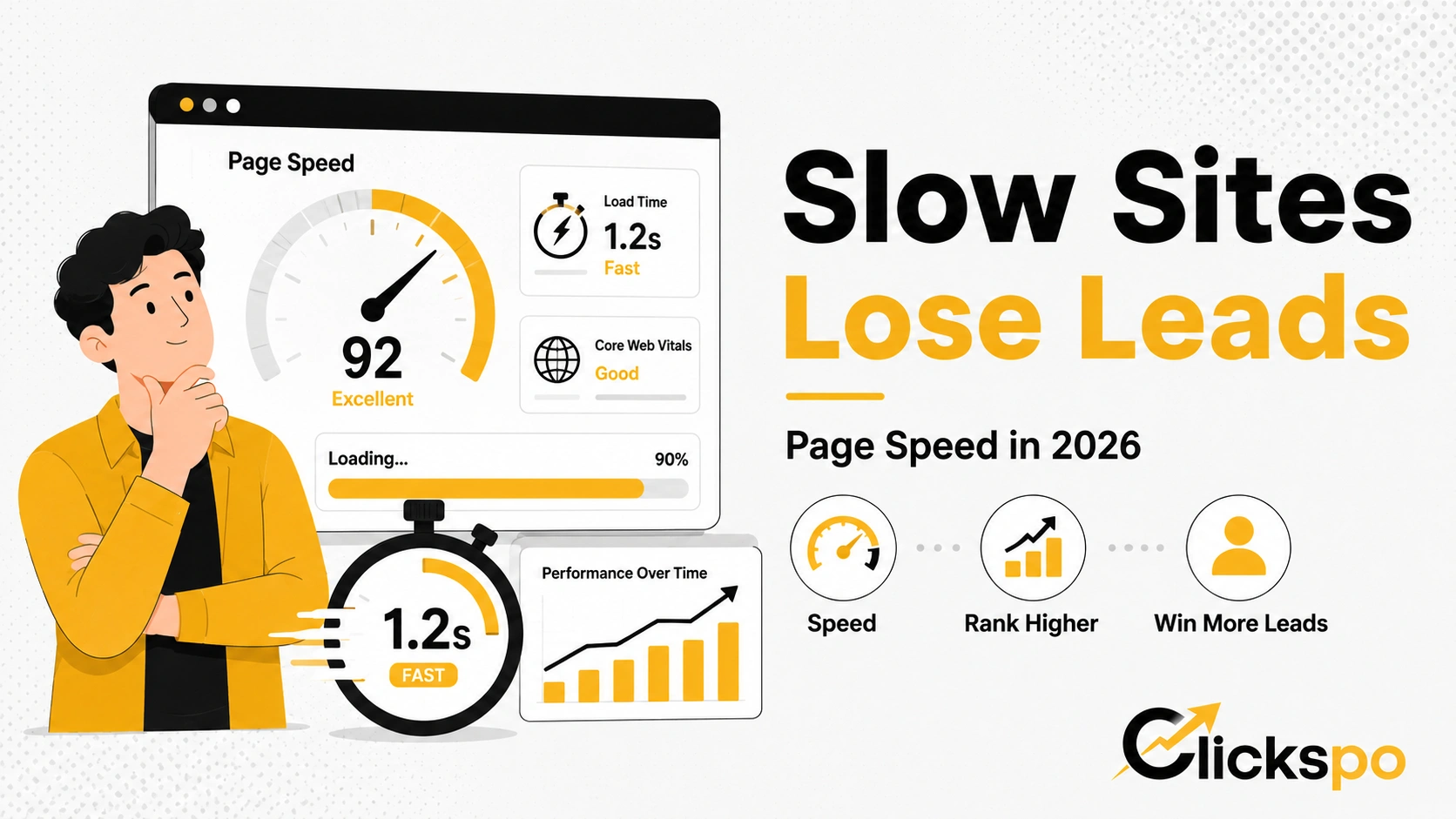
Page speed has been part of the SEO conversation since Google officially made it a ranking factor for desktop in 2010 and for mobile in 2018. In 2026, we still get asked whether it genuinely moves the needle or whether it has become one of those checkbox tasks that agencies obsess over without real business impact. Our answer, based on what we see across client accounts in Hong Kong, is that it matters more now than it did three years ago, but the way you should think about it has shifted considerably.
Page Speed as a Ranking Signal: What Google Actually Says
Google has confirmed page speed as a ranking factor, but the framing is important. Speed itself is not the primary driver of rankings. Google’s own documentation is clear that a slow page will not automatically be outranked by a fast but irrelevant one. Content quality and relevance still sit at the top of the priority stack.
What changed significantly with the rollout of Core Web Vitals as a ranking signal in 2021 is that Google gave speed a more structured, measurable form. Rather than assessing a vague notion of how fast a page loads, Google now evaluates three specific metrics:
- LCP (Largest Contentful Paint): How long it takes for the main content of a page to become visible. Google’s threshold for a good score is under 2.5 seconds.
- INP (Interaction to Next Paint): How quickly the page responds after a user interacts with it, such as clicking a button or a menu. Good is under 200 milliseconds. This replaced FID (First Input Delay) in March 2024.
- CLS (Cumulative Layout Shift): How much the page layout shifts unexpectedly while loading. A good score is under 0.1.
These are not abstract developer metrics. They describe the actual experience of a real person visiting your site on a real device. In Hong Kong, where a large share of search traffic comes from mobile devices on a mix of connection speeds, these numbers have direct practical consequences.
The Business Case Beyond Rankings
The ranking signal argument is actually the weaker of the two reasons to care about page speed. The stronger argument is what speed does to conversion rates and user behaviour.
The data from industry research consistently tells the same story:
| Page Load Time | Estimated Bounce Rate Increase |
|---|---|
| 1 second (baseline) | Reference point |
| 3 seconds | Bounce rate increases by approximately 32% |
| 5 seconds | Bounce rate increases by approximately 90% |
| 10 seconds | Bounce rate increases by approximately 123% |
For a law firm, dental clinic, physiotherapy practice, or gym in Hong Kong investing in SEO, the commercial implications are straightforward. If a potential client lands on your page from a search result and it takes five seconds to load, roughly nine out of ten additional visitors beyond the one-second baseline are leaving before they even see your content. The rankings you earned through content and backlinks are producing a fraction of the leads they should.
We have seen this pattern repeatedly across client accounts. A site ranking in position three with a slow load time on mobile will often underperform a site ranking in position five with a fast, smooth experience.
Core Web Vitals in Hong Kong: What Our Research Shows
Our keyword data from Ahrefs shows that “page speed” generates 100 monthly searches in Hong Kong with a keyword difficulty of 97, while “website speed test” generates 300 monthly searches. “Core web vitals” generates 60 monthly searches at a difficulty of 85 and a CPC of HK$80, indicating commercial intent from businesses actively trying to solve this problem.
The high difficulty scores are significant. They reflect the dominance of Google’s own PageSpeed Insights tool (pagespeed.web.dev), which holds the top ranking position with a domain rating of 92 and over 85,000 referring domains. This tells us that users searching around page speed are largely looking for diagnostic tools rather than educational content, which is exactly where a practical, experience-led guide like this one fills a gap.
For Hong Kong specifically, a few factors make page speed particularly consequential:
- Mobile traffic is the dominant share of visits for most local business websites
- Hong Kong users have high expectations for digital performance given the quality of local broadband and mobile infrastructure
- Competitive local search categories such as legal services, dental, and health clinics mean that small UX advantages compound over time
If you are running a technical SEO audit on a Hong Kong business site, Core Web Vitals should be one of the first sections you review, not an afterthought.
How to Diagnose Your Page Speed Issues
Before fixing anything, you need to know what is actually broken. The tools we use most frequently with clients are:
Google PageSpeed Insights (pagespeed.web.dev) is the starting point. It gives you both lab data (simulated test conditions) and field data (real user experience from the Chrome User Experience Report). Field data is what Google uses for ranking purposes, so if there is a discrepancy between the two, field data takes priority.
Google Search Console now has a dedicated Core Web Vitals report under the Experience section. It shows you which URLs are failing, which are borderline, and which are passing, segmented by mobile and desktop. This is where you get the real picture of how your site performs at scale.
GTmetrix provides a more developer-friendly breakdown of exactly what is slowing your page down, including waterfall charts of how each asset loads and where the time is being spent.
The most common issues we find when auditing sites are:
- Images that are too large or not in modern formats such as WebP or AVIF
- No lazy loading on images that appear below the fold
- Render-blocking JavaScript or CSS that delays the page from displaying content
- No caching configured, so every visit reloads all assets from scratch
- Hosting that is geographically distant from the Hong Kong audience
- Too many third-party scripts such as chat widgets, marketing pixels, and tracking tags loading on every page
Page Speed by Platform: What Hong Kong Businesses Need to Know
The platform your site is built on has a significant impact on your starting point for page speed performance.
| Platform | Default Speed Performance | Key Considerations |
|---|---|---|
| WordPress | Moderate | Plugin bloat and unoptimised themes are the most common culprits. A well-configured WordPress site with a lightweight theme can score well. |
| Shopify | Moderate to good | Core performance is handled by Shopify’s infrastructure, but third-party apps and heavy theme scripts are common drag factors. |
| Wix | Variable | Has improved significantly but custom code and large media libraries can still cause issues. |
| Custom-built sites | Depends entirely on development quality | Best potential ceiling but also highest risk if performance is not built in from the start. |
We have written separate guides covering Wix SEO, Shopify SEO, and WordPress SEO if you want platform-specific guidance on where page speed intersects with your wider SEO setup.
What a Good Score Actually Means
One of the most common misconceptions we encounter is the belief that you need to score 100 on PageSpeed Insights to be competitive. You do not. The goal is to reach the “Good” threshold on all three Core Web Vitals metrics as measured by field data, not to achieve a perfect lab score.
A site scoring 72 on PageSpeed Insights with good field data on LCP, INP, and CLS will outperform a theoretical 95-scoring site that has poor field data, because Google ranks based on what real users experience. The lab score is a proxy and a diagnostic tool, not the objective in itself.
For most business websites in Hong Kong, reaching a mobile PageSpeed score consistently above 60 to 70 and passing Core Web Vitals thresholds in field data is a realistic and impactful target. Chasing scores above 90 on mobile often requires tradeoffs in functionality or design that are not commercially sensible for most businesses.
FAQs About Page Speed and SEO
Does page speed directly affect my Google ranking in 2026?
Yes, but with an important qualification. Google uses Core Web Vitals field data as a ranking signal, which is a measure of the real experience visitors have on your site. Speed is one input among many. It will not single-handedly push you from page two to page one, but on competitive queries where other signals are relatively equal, it can be the deciding factor.
What is the most important Core Web Vitals metric to fix first?
LCP is typically the highest impact starting point because it directly affects how quickly users perceive your page as loaded. Poor LCP is often caused by large unoptimised hero images or slow server response times, both of which are fixable without major development effort. Fix LCP first, then address INP, then CLS.
Does page speed matter more on mobile or desktop?
Mobile is more critical for most Hong Kong business sites. Google uses mobile-first indexing, which means it evaluates and ranks your site based on the mobile version of your content and experience. If your mobile performance is poor but your desktop is fast, the ranking and user impact is still determined by the mobile experience.
How often should I check my page speed scores?
We recommend checking Core Web Vitals in Google Search Console monthly as part of a routine SEO review. After any significant site update, new plugin installation, or theme change, check immediately. Search Console will flag new failures within a few weeks of them appearing, but proactive monitoring catches issues faster.
Does hosting affect page speed for Hong Kong websites?
Significantly. Server response time (measured as Time to First Byte or TTFB) is a foundational element of LCP. Hosting on servers physically located in or near Hong Kong, or using a CDN with edge nodes in the region, reduces latency for local visitors. Cheap shared hosting on servers based overseas is one of the most common causes of slow TTFB we see on local business sites.
Can I improve page speed without a developer?
For some issues, yes. Compressing and resizing images before uploading them, installing a reputable caching plugin on WordPress, and removing unused plugins or scripts are all changes a non-developer can make. For render-blocking resources, server-side configuration, and code-level optimisation, you will generally need technical help. A technical SEO audit can identify exactly which issues require developer involvement and which you can address yourself.