
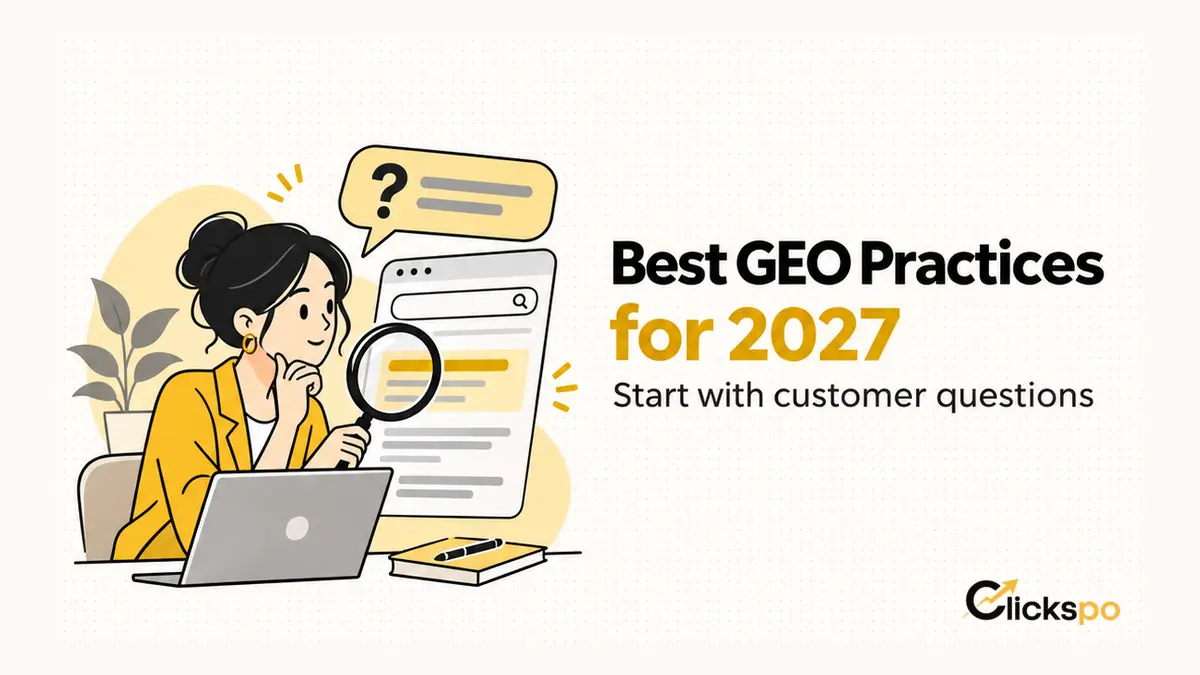
Getting our business mentioned in an AI answer starts with giving people a clear reason to trust and choose us. For 2027, we would prioritise content that answers real buying questions, evidence that supports our claims, and a website that search systems can access reliably. Generative engine optimisation, or GEO, brings these activities together. This guide sets out the practices we recommend preparing now, while recognising that no business can guarantee how AI platforms will select sources in 2027.
Key Takeaways
- Formulate articles around specific customer questions, including costs, comparisons, suitability and practical concerns.
- Give a useful answer early, then explain the conditions and evidence behind it.
- Publish original examples, findings and case studies that add something beyond existing search results.
- Maintain technical SEO, accurate business information and natural English and Traditional Chinese content.
- Measure brand mentions, source citations and qualified enquiries separately.
CLICKSPO • GEO PLANNING
Make every answer worth finding.
Ask the buying question
Costs · comparisons · suitability · next steps
Answer with evidence
Clear advice · original examples · honest limits
Connect visibility to enquiries
Track mentions, citations, visits and qualified leads separately.
2027 priority: useful content, accessible pages and a credible business.
What should GEO actually achieve for our business?
We approach GEO as a way to improve how our business is discovered and understood through AI search. A useful result might be a relevant recommendation, an accurate explanation of our services, or a citation that sends a potential customer to our website.
These outcomes have different commercial value. A passing brand mention in an unrelated answer is less useful than appearing when someone compares providers for a service we sell.
Our starting point is therefore a business question: which conversations should our company be part of? We identify the services, customer situations and buying decisions that matter before deciding what to publish. Our GEO services follow that broader focus on search visibility and business relevance.
How do we formulate articles around question based topics?
Start with the question a customer needs answered before taking the next step. A broad topic such as “accounting services” gives us a subject, but little editorial direction. “What should a small business prepare before outsourcing its bookkeeping?” gives us an audience, a situation and a clear purpose.
We recommend building a question map from sales conversations, customer emails, search queries and existing content gaps. Keyword research helps us check demand, but the final wording should sound natural.
For example, our Hong Kong keyword checks returned average monthly searches of 260 for “AI SEO” and 260 for “GEO SEO” across the available October 2025 to September 2026 period. These are separate keyword estimates, not a combined audience size, and they do not measure how often people ask AI assistants about the subject.
The practical lesson is to connect familiar search language with useful questions:
| Customer need | Example article question | What the answer should cover |
|---|---|---|
| Understand the service | What does GEO include for a Hong Kong business? | Scope, deliverables and responsibilities |
| Compare options | Should we invest in SEO or GEO first? | Existing visibility, technical condition and priorities |
| Assess cost | What affects the cost of GEO services? | Workload, languages, competition and reporting |
| Check suitability | Is GEO worthwhile for a business serving one district? | Local demand, service area and customer intent |
| Evaluate results | How can we tell whether AI visibility produces enquiries? | Measurement, attribution limits and lead quality |
These are editorial examples, rather than claims that each exact question has measured search volume.
Avoid creating a separate page for every wording variation. Questions that need substantially the same answer usually belong together. Separate articles earn their place when the reader needs different evidence, advice or next steps.
What makes an answer useful enough to stand on its own?
We give the answer near the beginning of the relevant section, then explain what could change it.
For a question about service costs, “prices vary depending on your requirements” leaves the reader where they started. A stronger answer identifies the factors: the number of services covered, the condition of the website, the languages required and the amount of original content involved.
A useful section should help someone understand:
- What we recommend.
- Who the recommendation suits.
- Which conditions or exceptions matter.
- What evidence supports the explanation.
- What they should do next.
Clear writing helps people judge the answer. We would not treat a particular paragraph length, question mark or formatting pattern as a guaranteed way to secure an AI citation.
What original evidence should we publish?
The strongest contribution we can make is information grounded in our own work.
Consider an agency case study. “We improved visibility” tells a reader very little. A useful account explains the starting position, the work completed, the period measured and the outcome. It also identifies other changes that could have influenced the result, such as advertising activity or a website redesign.
Depending on the business, worthwhile evidence could include:
- A documented project with a clear starting point and outcome.
- Product photographs showing details customers ask about.
- A worked example explaining how a service is delivered.
- An anonymised analysis of recurring customer problems.
- A comparison based on consistent, disclosed criteria.
We should obtain the necessary permission, protect confidential information and describe limitations honestly. A small, well explained example is more credible than a large claim without context.
Which website foundations should we fix first?
A useful article still needs to be accessible. We would check that important pages load properly, contain readable text, have sensible internal links and can be discovered by the search systems we want to reach.
Our technical review would cover:
- Accidental indexing restrictions on public pages.
- Broken links and pages that return errors.
- Conflicting canonical settings or unnecessary duplicates.
- Important information available only inside images.
- Mobile layouts that hide answers or obstruct enquiries.
- Relevant crawler access and platform visibility settings.
Structured data should accurately describe the visible page. We would use suitable markup where it serves a clear purpose, without presenting a special “GEO schema” as a requirement or guarantee.
Technical fixes support discovery; they do not remove the need for useful content and a credible business.
How do we make our business easier to understand and verify?
We keep the essentials consistent: our business name, services, locations, contact details and the people responsible for our work.
Vague descriptions create uncertainty. “We provide innovative solutions” says less than a straightforward explanation of what we deliver, who we serve and where we operate. Team profiles, relevant qualifications, genuine reviews and detailed service pages help prospective customers assess us.
We also pursue legitimate opportunities to share expertise through partnerships, industry activity and relevant editorial coverage. Buying fabricated reviews or manufacturing supposedly independent recommendations undermines the trust we are trying to build.
For Hong Kong businesses, language needs the same attention. We write Traditional Chinese around local customer concerns rather than copying English sentence structures. Prices, scope and contact details should remain consistent across both versions.
How should we measure GEO performance?
We separate visibility from business outcomes. An AI platform can mention our name without linking to us, or cite our article without recommending our services.
| Measure | What we record | What it cannot prove alone |
|---|---|---|
| Brand mentions | Whether our company appears in relevant answers | That the answer recommends us |
| Source citations | Whether an answer links to our content | That someone visited |
| Referral visits | Visits attributed to an AI platform | Every visit influenced by AI |
| Qualified enquiries | Relevant leads and their stated discovery sources | Complete attribution for the buying journey |
We keep a consistent set of prompts and record the platform, language, date and available search settings. Repeated observations are more useful than a single favourable screenshot.
Our guide to measuring AI search visibility and referrals explains how these measures fit together. We also review lead quality, since greater visibility has limited value if it attracts the wrong customers.
What should we prioritise before 2027?
We would begin with the pages closest to revenue. Improve the service explanation, answer the questions that delay enquiries, and add evidence that helps customers assess the offer.
A practical starting sequence is:
- Review core service pages and remove technical obstacles.
- Select the customer questions with the clearest commercial relevance.
- Improve existing answers before commissioning overlapping articles.
- Add original evidence and a clear next step.
- Establish a repeatable visibility and enquiry baseline.
- Update content when the underlying information changes.
At Clickspo, we bring research, content, technical implementation and reporting into the same workflow. The purpose is to make each improvement useful to a prospective customer and measurable against a business goal.
Frequently Asked Questions
Should every article heading be a question?
No. We use question headings when they match a genuine reader concern. A descriptive heading can work better for a checklist, example or comparison. The article should answer its central question without forcing every section into the same pattern.
Can we use AI to help write GEO articles?
Yes. We can use AI to organise research, develop outlines and identify gaps. Someone with relevant knowledge should check the finished article, verify claims and add original insight. Publishing an unchecked draft can introduce inaccurate details about our own services.
How often should we publish new content?
We choose a pace we can sustain with useful research and editorial review. A business with several unanswered buying questions may need new articles; another may gain more from improving existing service pages. Publication frequency alone does not demonstrate quality.
Can we guarantee that our business will appear in AI answers?
We cannot control an independent platform’s answer for every user or prompt. We can improve the website, evidence and information available about the business, then monitor results consistently. Any commercial commitment should define the platform, queries, measurement and conditions precisely.