SEO vs Google Ads: Which One Drives Better ROI for Businesses?

Hector Law
Hector is the Co-Founder of Clickspo, and has over 7+ years of SEO and website marketing experience.
He was the SEO Lead of a MNC SEO agency, leading a team of over 14 professionals.
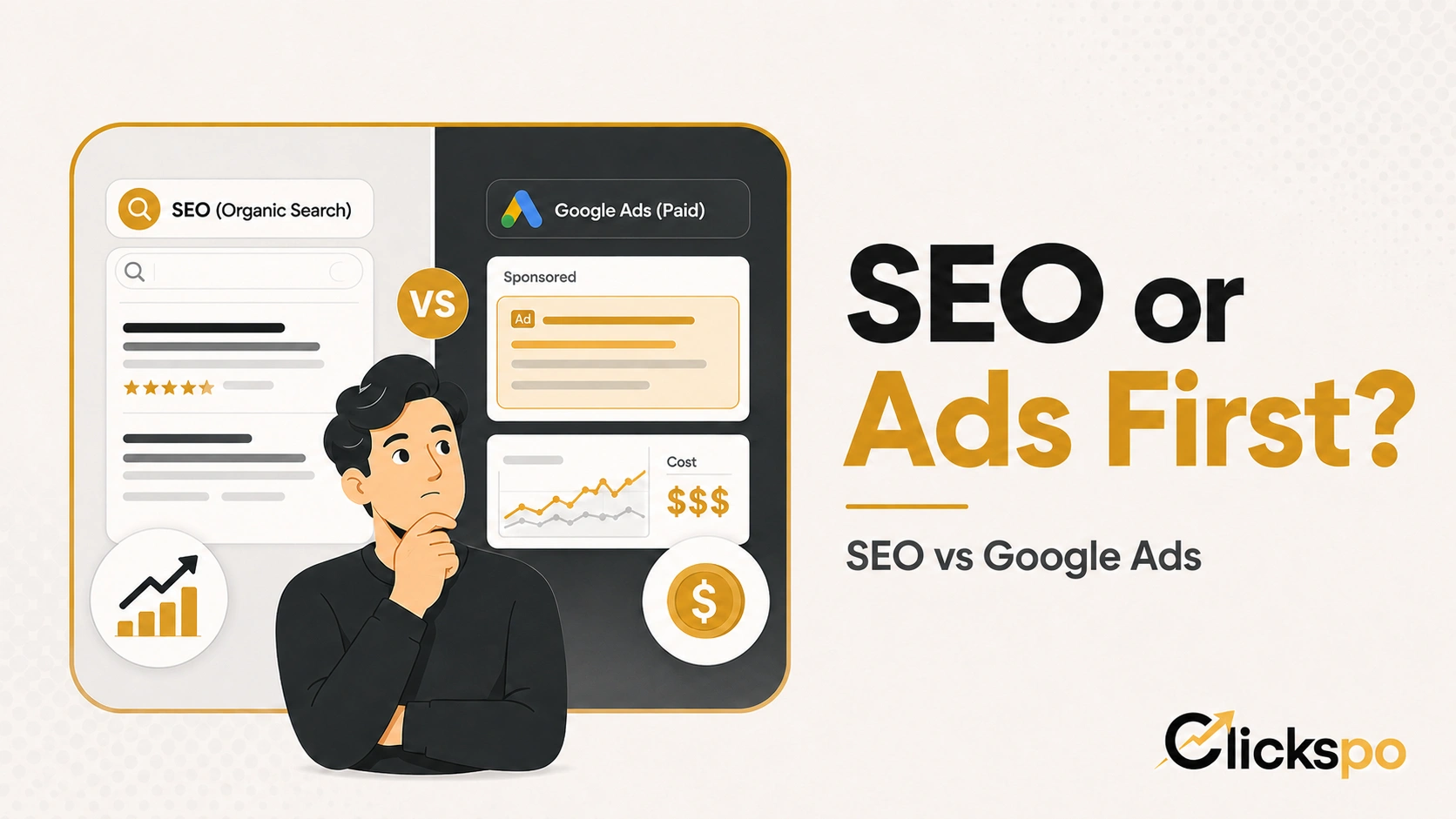
If you run a service business, your marketing budget likely goes into one of two channels:
- SEO (Search Engine Optimization)
- Google Ads (Pay-Per-Click Advertising)
Both generate leads. Both can drive revenue. But their ROI profile is completely different.
Using real 2026 keyword data, let’s break down which channel delivers stronger returns – and when.
Demand & Competition: What the Data Shows
Before debating ROI, we need to understand market economics.
Here’s current keyword data (Hong Kong market sample):
| Keyword | Avg. Monthly Searches | Competition Level | Top of Page Bid (Low–High) |
|---|---|---|---|
| seo services | 260 | Medium (37 index) | HKD 36.24 – 97.70 |
| seo optimization | 70 | High (70 index) | HKD 14.57 – 75.01 |
| seo google ads | 10 | Very High (100 index) | — |
| seo web | 40 | High (73 index) | HKD 25.27 – 71.01 |
What This Tells Us:
- There is real demand (260 searches/month for “seo services”).
- Advertisers are actively bidding.
- Cost per click can reach nearly HKD 100 in competitive scenarios.
- Competition is high in most commercial keywords.
Now let’s translate that into ROI implications.
Google Ads ROI: Immediate but Expensive
With Google Ads, you pay per click.
If your average CPC is:
- HKD 50 (mid-range)
- And your landing page converts at 10%
You’re paying roughly:
- HKD 500 per lead.
If your close rate is 30%, your cost per client becomes:
- HKD 1,667 per customer acquired.
This can still be profitable – depending on your service value.
Google Ads Strengths
- Immediate visibility
- Instant traffic
- Great for urgent or transactional services
- Excellent for testing keyword demand
But There’s a Catch
- Costs increase as competition rises
- High-intent keywords get more expensive over time
- The moment you stop paying — traffic stops
Google Ads is rented visibility.
SEO ROI: Slower, But Compounding
Now let’s look at the same keyword example from an SEO lens.
If you rank organically for:
- “seo services” (260 searches/month)
- Even capturing 30% of clicks
That’s ~78 organic visitors monthly from one keyword.
Multiply that across 20–30 commercial keywords and your traffic scales without paying per click.
The Real Advantage
Unlike Google Ads:
- You don’t pay HKD 36–97 per click
- Competition doesn’t increase your cost per visitor
- Traffic compounds month after month
Your cost per lead decreases over time.
Cost Per Lead: 12-Month Comparison
Let’s simplify this.
Scenario 1: Google Ads Only
- 200 clicks/month
- HKD 50 average CPC
- HKD 10,000 monthly spend
- 10% conversion rate → 20 leads
- Cost per lead = HKD 500
Stable but dependent on ad spend.
Scenario 2: SEO Investment
- HKD 10,000/month investment
- 4–6 months ramp-up
- Month 8 onward: 800 organic visitors
- 10% conversion rate → 80 leads
- Effective cost per lead = HKD 125
- And it continues improving as traffic grows.
This is where ROI flips heavily in SEO’s favor.
Lead Quality: Organic vs Paid
One consistent pattern across service businesses:
- Organic leads often convert better.
- Users trust organic listings more than ads.
- They typically browse multiple pages before enquiring.
Ads attract strong buying intent – but they also attract price shoppers and comparison traffic.
SEO traffic tends to be:
- More research-driven
- More brand-aware
- Less click-and-leave behavior
Over time, organic channels often produce higher-quality inquiries.
Risk Profile: Which Is Safer?
Google Ads Risk
- Rising CPCs due to bidding wars
- Algorithm updates impacting ad performance
- Conversion dependency on landing page quality
- Budget sensitivity
- If your margins are thin, rising ad costs can destroy ROI quickly.
SEO Risk
- Slower initial ramp-up
- Requires strategic execution
- Technical and content quality matter heavily
- But once rankings are secured, volatility is far lower than PPC cost fluctuations.
When Google Ads Delivers Better ROI
Google Ads makes sense when:
- You need immediate revenue
- You’re launching a new service
- You’re entering a new market
- You’re testing commercial viability
- You have strong margins
- It’s ideal for short-term acceleration.
When SEO Delivers Better ROI
SEO wins when:
- You plan to operate long term
- Your services have consistent search demand
- You want to reduce dependency on paid traffic
- You want scalable, predictable acquisition
- You want to build brand authority
For established service businesses, SEO almost always produces the stronger ROI after 6–12 months.
The Most Profitable Strategy: Layering Both
The highest-performing service businesses don’t choose one.
They sequence them.
Phase 1: Use Google Ads to Capture Immediate Demand
- Generate cash flow
- Identify highest-converting keywords
- Refine messaging
Phase 2: Build SEO Around Proven Converting Keywords
- Rank organically for high-CPC terms
- Reduce paid spend gradually
- Increase margins
You use paid traffic as fuel — and SEO as infrastructure.
The Real ROI Question
The debate isn’t:
“Which channel is better?”
The real question is:
Do you want to rent traffic forever — or build an asset that lowers your acquisition cost every year?
- Google Ads is predictable but expensive.
- SEO is slower but compounding.
For service businesses thinking beyond the next 90 days, SEO typically drives the stronger long-term ROI – especially in competitive markets where CPCs already range between HKD 36-97 per click.
Final Thoughts
If your goal is:
- Immediate leads → Start with Google Ads.
- Sustainable growth → Invest in SEO.
- Maximum profitability → Combine both strategically.
The businesses that win don’t chase clicks.
They build systems that reduce acquisition cost over time while increasing lifetime value.
That’s where real ROI lives.