
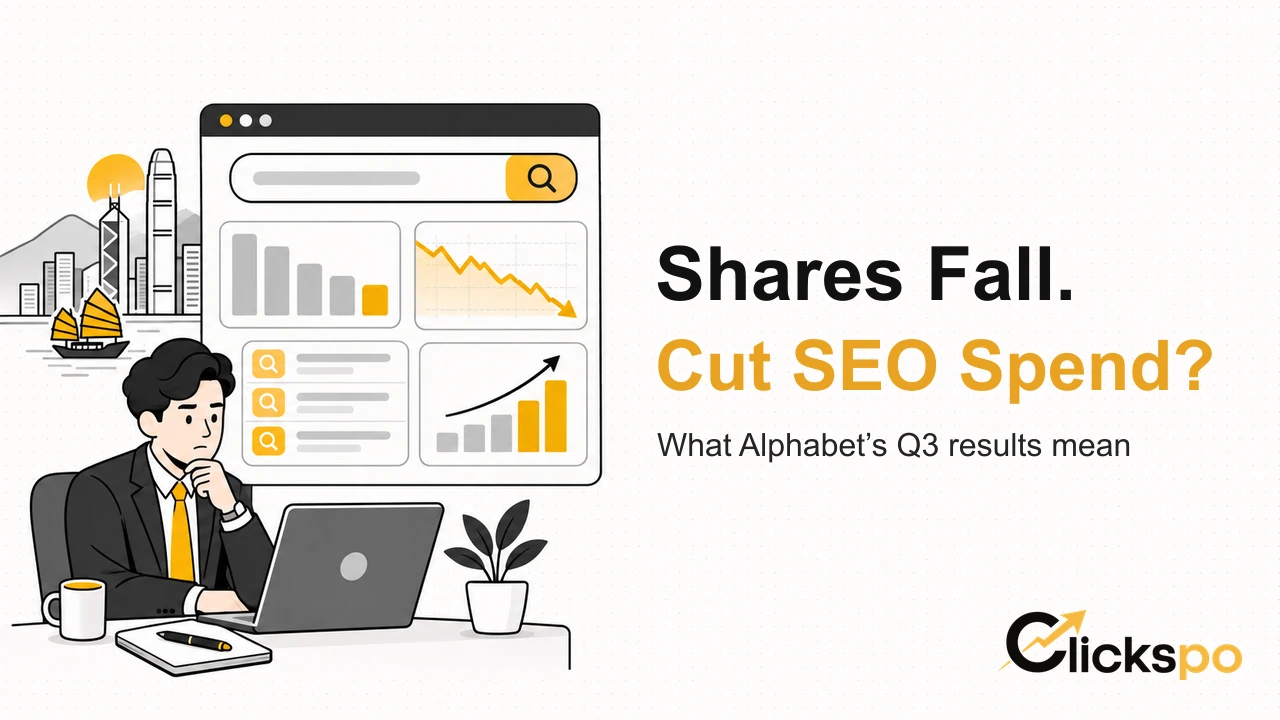
Alphabet’s Class A shares fell 12.6% on 29 October 2026, the day after Google’s parent company reported its third quarter results. Yet revenue from Google Search & other grew 12% year on year to US$63.35 billion. For a Hong Kong business reviewing its SEO budget, those figures leave one important question unanswered: are fewer people finding the business, or are people still finding it and taking a different route to enquiry?
The answer depends on which searches changed. Losing visits from people looking up a definition has a different commercial cost from losing customers who were ready to ask for a quote.
What to take into your next SEO review
- Find the pages behind the traffic drop. Separate guides and definitions from pricing, location and booking pages. Check which group accounts for the lost clicks.
- Follow enquiries through to sales. A form submission, a qualified lead and a confirmed booking are three different outcomes. Agree with your agency which one matters for the budget decision.
- Give AI visibility its own measure. Record whether an AI answer mentions your business, recommends it or links to your website. Each tells you something different about how a customer might discover you.
What Alphabet’s earnings tell us about search
Investors were weighing slower growth in search advertising alongside the cost of building AI infrastructure. Google identified currency movements as the largest reason search revenue growth slowed from the previous quarter. It also said AI Mode generated less revenue per query. For marketers, three distinctions matter:
- Search revenue measures advertising income. It tells you how much Google earned. Your own Search Console data shows whether customers saw and clicked your organic listings.
- An AI answer can satisfy a search on the spot. Someone who gets a complete definition in an AI Overview may have little reason to open the guide that still ranks underneath it.
- Your advertising costs depend on your campaigns. Before moving money out of Google Ads, check the actual cost per qualified enquiry and per sale in your account. Alphabet’s share price cannot supply either figure.
Why rankings can hold while clicks fall
Consider a Hong Kong meeting room operator. Someone searching “what is a serviced office?” may get everything they need from a paragraph on Google. Someone asking “where can I book a meeting room for 12 in Central after 7 pm?” still needs a venue with the right capacity, a confirmed evening rate and an available slot.
Suppose the operator’s website promises “flexible meeting solutions” but leaves out the last booking time and evening surcharge. Adding those two details gives a prospective customer a reason to enquire. It also makes the page a more useful source for someone comparing venues in an AI answer.
| What changed? | What should the agency check? | What decision follows? |
|---|---|---|
| A guide holds its ranking but loses clicks | Inspect results for its main queries. Record whether an AI Overview, map or advert appears above the listing. | Rework the guide if you can offer something the results page leaves unanswered, such as a local price comparison. |
| A service page loses clicks and bookings | Check indexing, local demand, competing offers and the enquiry form. | Fix the issue affecting bookings before commissioning more articles. |
| AI impressions rise but visits stay flat | Use Search Console’s generative AI report to see which URLs appeared. Review enquiries and referral traffic separately. | Track visibility over time and look for evidence that customers used it. |
| Overall visits fall but bookings hold | Identify which pages still bring in paying customers. | Preserve the work supporting those pages and reassess the content that lost traffic. |
Repeat checks using the same market, language, device and comparable dates. One search result is a useful observation; a series of comparable observations gives you a stronger basis for a decision. Clickspo’s Google AI Overviews and AI Mode checklist
What should an agency deliver for GEO?
Generative engine optimisation, or GEO, starts with a customer question you can test. For the venue operator, a useful brief would be: “When someone asks for an evening meeting space in Central, which venues appear, and does the answer give the correct rates and hours?”
Ask for four deliverables:
- A set of real buying questions. Draw them from calls, emails and booking enquiries. Include the wording customers naturally use in English and Traditional Chinese.
- A separate record for each platform. Save the question, date, answer and linked sources for Google and ChatGPT. If Google shows no AI Overview, record that explicitly. If an Overview appears and names competitors, keep that answer for comparison.
- A correction you can inspect. The agency might add evening rates to a venue page, correct outdated information in an event directory or publish a floor plan showing how many people fit around one table.
- A repeat test. Run the same questions under comparable conditions. Report what changed in the answers, which sources appeared and whether any visits or enquiries can be traced to them.
This makes digital PR easier to judge, too. A directory used by event planners may be worth updating because it helps buyers shortlist a venue. Before paying for a placement, ask to see its audience, the information it will publish and how readers can reach the booking page. How brand mentions differ from AI citations
Where should the next marketing dollar go?
Start with the place where the business is losing customers. The meeting room operator could make any of the following decisions from the same monthly review:
- Maintain SEO on profitable pages if location and pricing searches continue to generate confirmed bookings. Keep availability, rates and contact details accurate.
- Review paid search if adverts produce plenty of enquiries but few sales. Check the terms customers searched and why the sales team rejected the leads.
- Test GEO on one service if competitors repeatedly appear for a buying question your business can answer well. Set a review date and define what the agency will measure before expanding the work.
- Build a direct route back for existing customers by inviting past bookers to opt in to emails about new evening slots or seasonal packages. Track repeat bookings from those messages before investing in a larger programme.
At the next review, ask the agency to finish this sentence: “We recommend spending the next dollar here because we observed ___, and we’ll judge the result by ___.” A specific answer gives you a decision you can revisit next month. How to measure AI search visibility and referrals
Frequently asked questions
Does a small business need a separate GEO retainer?
Start by checking what your existing SEO agreement covers. Updating inaccurate opening hours, publishing prices or improving a service page may already be included. A separate GEO budget is easier to justify when the agency can show which customer questions it will track, what additional work it will do and when you can review the results.
Can a business tell whether an AI mention led to a sale?
Sometimes a referral link or a customer’s account provides a clear clue. A buyer might also read an AI answer, search the company name the next day and book by phone. Ask new customers how they first heard about you, and keep their answers separate from referrals recorded by analytics. Both are useful, but they measure different things.
What if the English query triggers an AI Overview and the Chinese query does not?
Report the two outcomes separately. For English, record the brands and sources in the answer. For Chinese, mark the observation as “no AI Overview shown” and check again on the next review date. Treating that result as a brand omission would give the business the wrong problem to solve.