
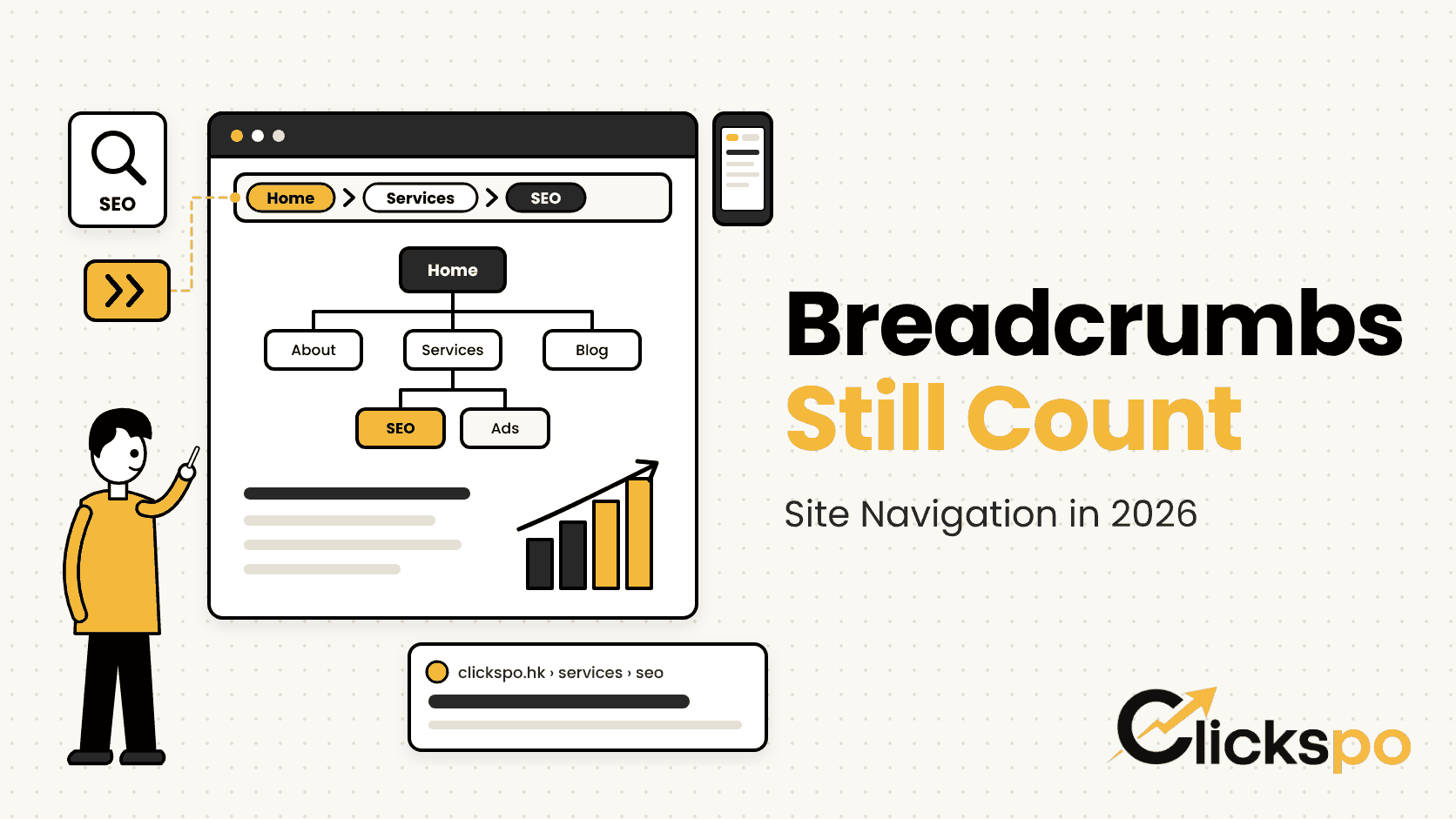
Breadcrumbs are the small trail of links near the top of a page, such as Home › Services › SEO. They look minor, and since Google stopped showing them in mobile search results, many site owners assume they no longer matter. In our audits for Hong Kong clinics, law firms and online shops, we see the opposite. Breadcrumbs still help visitors find their way, still describe your site hierarchy to search engines and still power breadcrumb structured data. So are breadcrumbs still important for SEO in 2026? Yes, and here is how we set them up properly.
What Breadcrumbs Are and Why They Exist
Breadcrumb navigation is a secondary menu that shows where the current page sits within your website. Each step in the trail is a link back to a parent page, so a visitor reading an article about root canal treatment can jump straight back to the wider treatments section or the home page in one click.
There are three common types:
- Hierarchy based. The trail follows your site structure, for example Home › Practice Areas › Family Law › Divorce. This is the type we recommend for almost every business site.
- Attribute based. Common on ecommerce filters, for example Rings › Gold › Lab Grown Diamond. Useful on Shopify and WooCommerce stores with many product filters.
- History based. The trail shows the pages a visitor has just viewed. This simply repeats the browser’s back button and adds little value for search.
Interest in the topic is steady. Ahrefs data for the US market shows “breadcrumb navigation” at around 1,000 monthly searches with a keyword difficulty of 17, while “breadcrumbs seo” and “breadcrumb schema” each sit at around 700. People are still asking how breadcrumbs work, and plenty of sites still get them wrong.
Are Breadcrumbs Still Important for SEO in 2026?
Yes. Breadcrumbs are not a ranking shortcut, but they support three things search engines care about: a clear site structure, strong internal links and pages that are easy to use. Google’s own documentation continues to describe breadcrumbs as a way to understand and categorise the information on a page, and breadcrumb structured data remains a supported feature.
It also helps to be clear about what breadcrumbs cannot do. They will not lift a thin page above stronger competitors, and they cannot fix a messy site on their own. They work best on top of the fundamentals: a sensible structure, useful content, a clear H1 tag on every page and a site that loads quickly. When those are in place, breadcrumbs tie everything together for visitors and crawlers alike.
Site Hierarchy Signals
A breadcrumb trail spells out the parent and child relationship between pages. When every service page sits under a Services hub and every article sits under a clear topic category, search engines can see how your content is organised and which pages act as the main hubs. This matters most for sites with deep structures, such as a medical group with dozens of treatment pages or a retailer with hundreds of products.
Internal Links on Every Page
Each breadcrumb is a real link with descriptive anchor text. That means every inner page automatically links back to its category and to the home page, which spreads authority up the structure and helps crawlers reach important hub pages. It works alongside a planned internal linking strategy rather than replacing it.
Better Navigation for Visitors
Visitors who land on a deep page from search often want to see related options. A breadcrumb lets them move up a level without hunting through a menu, which is especially helpful on mobile, where the main navigation is usually tucked behind an icon.
How Google Shows Breadcrumbs in Search Results
Breadcrumbs used to appear in place of the plain URL on both desktop and mobile results. In early 2025, Google simplified mobile results so that they show only the site name and domain, while desktop results can still display the breadcrumb path. The table below summarises where breadcrumbs appear and what still depends on them.
| Where | What Google shows | Why breadcrumbs still matter |
|---|---|---|
| Desktop search results | Domain followed by the breadcrumb path | A readable path tells searchers which section of your site they are about to visit |
| Mobile search results | Site name and domain only | The trail on the page still guides visitors once they arrive |
| Structured data | Read by Google, not shown as a separate feature | BreadcrumbList markup describes your hierarchy in a machine readable way |
| AI search and assistants | Summaries built from pages they understand | Clear structure makes it easier to see what a page is about and where it belongs |
The change on mobile is a display change, not a sign that breadcrumbs stopped counting. The structure, the links and the markup are all still there for search engines to read. Clear structure also supports how pages are interpreted in AI search optimisation.
Breadcrumb Structured Data Explained
A visible trail helps people. Breadcrumb structured data helps machines. It uses the schema.org BreadcrumbList type, usually written in JSON LD, to list each step in the trail with its name, URL and position. Our guide to structured data covers the wider picture, but for breadcrumbs the rules are simple:
- Match the visible trail. The markup should describe the same path a visitor sees on the page.
- Use real, indexable URLs. Every step except the current page should link to a live page that returns a normal response, not a redirect or an empty archive.
- Keep the order logical. Position one is the top level, and each step moves one level deeper.
- Output it once. Only one tool should generate breadcrumb markup, otherwise Google sees conflicting versions.
- Test it. Run key templates through Google’s Rich Results Test and watch the breadcrumbs report in Search Console.
Most WordPress sites do not need hand written markup. A good SEO plugin generates it automatically once breadcrumbs are switched on.
How to Set Up Breadcrumbs in Rank Math and Your Theme
On WordPress, breadcrumbs usually come from either the SEO plugin or the theme. Our team picks one source and makes sure everything else is switched off. With Rank Math, the process looks like this:
- Go to Rank Math, then General Settings, then Breadcrumbs, and turn breadcrumbs on.
- Set the separator, the home label and whether the trail shows the post category.
- Add the trail to your templates with the
shortcode or therank_math_the_breadcrumbs()function in the theme file. - If your theme has its own breadcrumb option, such as Astra or Kadence, check whether it can use Rank Math as the source, or disable the theme version.
- Choose a primary category for each post so the trail follows the path you intend.
Rank Math adds BreadcrumbList markup when its breadcrumbs are enabled, so there is no need for a separate schema plugin. Page builders such as Elementor also offer breadcrumb widgets that pull from Rank Math. Whatever the setup, check the trail on a live page on both desktop and mobile, since some themes hide it on small screens. Getting these details right is a standard part of our WordPress SEO work.
Common Breadcrumb Mistakes
The same problems come up again and again when we run a technical SEO audit. Duplicate markup from a plugin and a theme is the most frequent. Next are trails that point to category pages which redirect, return errors or contain almost nothing. Last is the classic Home › Uncategorised trail, which tells visitors and search engines nothing about where a page belongs.
Fixing these is usually quick. The harder part is the category structure behind them, which is why we always plan site sections before switching breadcrumbs on.
FAQs About Breadcrumbs and SEO
Do breadcrumbs directly improve rankings?
Not on their own. Breadcrumbs support SEO indirectly by clarifying site structure, adding internal links and improving navigation. Think of them as part of a well organised site rather than a separate ranking factor.
Should the home page show a breadcrumb?
No. The home page is the top of the trail, so there is nothing to show above it. Breadcrumbs belong on inner pages, posts, categories and products.
Should the last item in the trail be a link?
The last item is usually the current page, so it does not need to link to itself. Showing it as plain text is the common convention and keeps the trail clear for visitors.
Do Shopify stores need breadcrumbs too?
Yes, particularly stores with many collections. Many Shopify themes include a breadcrumb option, but it often needs adjusting so the trail follows collections in a logical order and the markup is not duplicated by an app.
How do breadcrumbs work on a bilingual site?
Each language version should have its own trail in that language, linking to the matching parent pages. An English page links up to English categories, and the Traditional Chinese version links up to Traditional Chinese categories.