
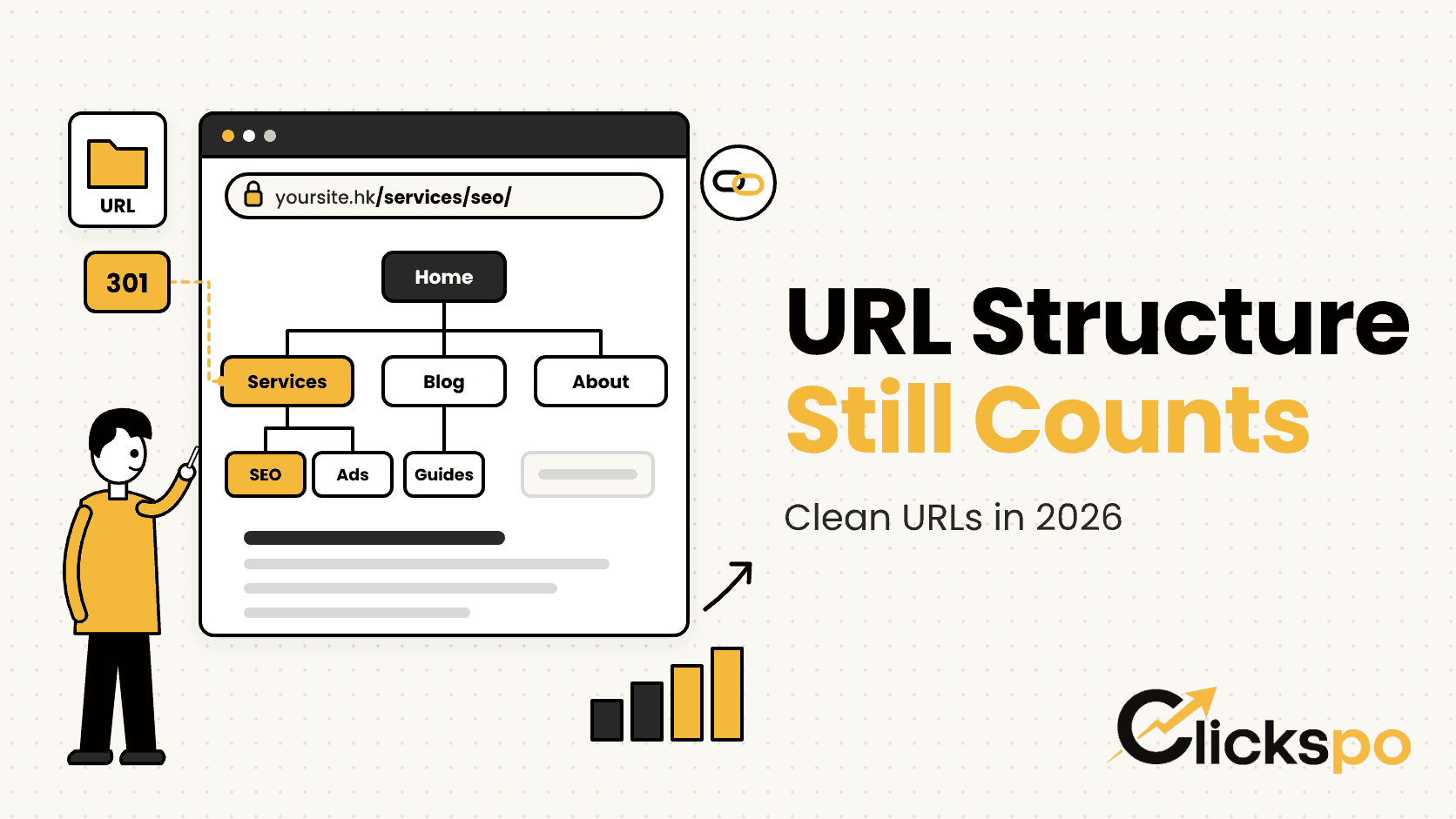
Every page on your website has an address, and that address says more than most site owners realise. A clear URL tells visitors where they are, tells Google how your content is organised, and makes a link easier to trust when it is shared on WhatsApp or LinkedIn. With AI search and rich results changing how pages appear, it is fair to ask whether URL structure still matters for SEO in 2026. Our answer is yes. It is a small signal on its own, but it shapes how your whole site is understood and maintained.
What URL Structure Means for SEO
URL structure is the way the addresses on your website are written and organised. It covers three things: the words in each address, the folders that group pages together, and how consistently those rules are applied across the whole site.
A simple example shows the difference. An address such as /services/seo/ tells a person and a search engine that this page sits inside a services section and is about SEO. An address such as /index.php?page_id=4821 tells them almost nothing. Both pages can rank, but only one explains itself before anyone clicks.
Interest in the topic remains steady. Ahrefs data for the US market shows “url structure seo” at around 1,000 monthly searches and “seo friendly urls” at around 800, with keyword difficulty of 34 and 24 respectively. People are still asking how to get this right, which matches what we see when Hong Kong businesses come to us after a redesign.
Does URL Structure Still Affect Rankings in 2026?
Google’s own documentation on URL structure still recommends simple, descriptive URLs that use readable words rather than long ID numbers. Google has also been clear that keywords in a URL are a very light ranking factor. Both statements are true at once, and that is the honest picture.
Where URL structure earns its place is indirect. It helps in four practical ways:
- Crawling and discovery. A logical folder structure makes it easier for search engines to understand which pages belong together and which sections matter most.
- Click confidence. Searchers see a version of your URL as a breadcrumb in results. A readable path looks more trustworthy than a string of parameters.
- Link sharing. When someone pastes your link into an email or a chat, a clean address shows what they are sharing and earns more clicks.
- Site maintenance. Consistent URLs make reporting, redirects and content audits far simpler for your team and ours.
AI search tools also rely on clear page context. A tidy address is not a ranking trick, but it is one more consistent signal that supports the headings, content and structured data around it.
What Makes a URL SEO Friendly
When we build or audit a site, we check every address against a short set of principles. The table below shows the difference between a weak pattern and the version we would recommend.
| Element | Weak pattern | Recommended approach |
|---|---|---|
| Words | ID numbers and random codes | Short, readable words that describe the page |
| Length | Full article titles with filler words | Three to five meaningful words |
| Case | Mixed capitals that create duplicate versions | Lowercase throughout |
| Parameters | Tracking and session codes in indexable URLs | Parameters kept out of pages you want indexed |
| Dates | Year and month folders on evergreen content | No dates unless the content is truly time bound |
| Separators | Underscores or spaces | Hyphens between words, as Google recommends |
A note on keywords: include the main topic of the page naturally, but do not stuff variations into the address. A clinic page about physiotherapy for back pain does not need every related phrase in its URL. If you are unsure which term to use, your keyword research should already have answered that question for the page.
Folders, Hierarchy and How Google Reads Your Site
Folders are where URL structure moves from single pages to the whole website. A Hong Kong law firm, for example, might group practice areas under one folder, team profiles under another, and articles under a third. Anyone reading the address knows immediately which part of the site they are in.
We follow a few rules when planning hierarchy:
- Keep it shallow. Most pages should sit no more than two or three folders deep.
- Match the folders to how customers think, not to how your internal departments are organised.
- Use the same pattern for every page of the same type, so a new service page always lands in the same place.
- Support the structure with navigation, breadcrumbs and internal linking, because folders alone do not pass authority between pages.
Hierarchy also helps when a site grows. An education centre that starts with five course pages and later adds fifty can keep everything organised if the folder plan was set early. Your XML sitemap then reflects a clean structure rather than a scattered list, which we cover further in our guide on whether sitemaps still matter.
Platforms handle this differently. WordPress lets you set permalink rules and category bases, while Shopify fixes some folders such as products and collections. When we work on WordPress SEO projects, permalink settings are one of the first things we review.
Chinese Characters in URLs for Hong Kong Bilingual Sites
This is the question we hear most often from Hong Kong clients running English and Traditional Chinese versions of the same site. Can a URL contain Chinese characters, and should it?
Google can read and index URLs written in Chinese. Browsers display them in Chinese in the address bar. The catch appears when the link is copied and pasted. Outside the browser, Chinese characters are converted into percent encoding, so a short, friendly address becomes a long string of symbols and letters in emails, chat apps, analytics reports and spreadsheets.
Our usual recommendation for bilingual businesses looks like this:
- Separate languages with a clear folder, such as
/en/and/zh/, or a consistent subdirectory for each language. - Use short English or pinyin words for the page itself in both versions, so links stay readable everywhere they are shared.
- Write the page title, headings and content fully in Chinese, because that is where the language signal really matters.
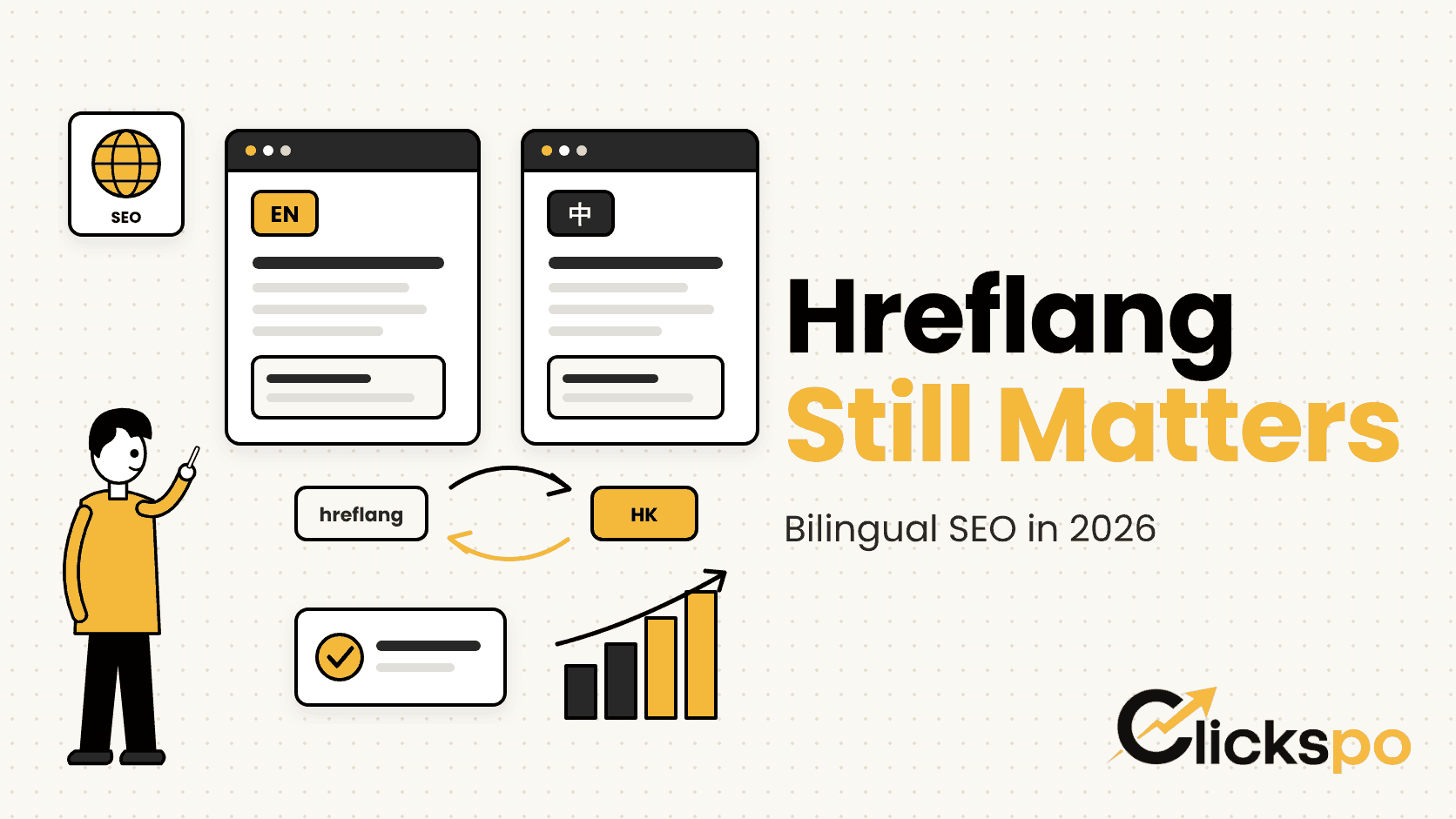
- Connect each language pair with hreflang tags so Google shows the right version to the right audience.
Some brands do choose Chinese URLs for local recognition, and that can work. The key is to make a deliberate decision once and apply it consistently, rather than mixing styles page by page.
Changing URLs Safely With 301 Redirects
Knowing what good looks like often tempts businesses to rename every URL on the site. Our advice is to be careful. Every changed address needs a plan, because old links, bookmarks and search results still point to the previous version.
When a change is worth making, such as during a redesign or a platform migration, we follow a set process:
- Export every existing URL, including pages with backlinks and steady organic visits.
- Map each old address to the single most relevant new page, never to the homepage by default.
- Set permanent 301 redirects, one step only, with no chains of several redirects in a row.
- Update internal links, menus, canonical tags and the sitemap so they point directly at the new URLs.
- Monitor Google Search Console for crawl errors and fix any missed pages quickly.
Canonical tags deserve special attention during this work. If a redirected page still declares its old address as canonical, you send Google mixed messages. Our article on canonical tags explains how to keep them aligned. For larger migrations, a full technical audit before and after launch is the safest way to catch issues early.
If your current URLs are readable and working, leaving them alone is often the better choice. Clean structure is most valuable when it is planned at the start.
FAQs About URL Structure
Should I include my target keyword in every URL?
Include the main topic of the page when it fits naturally, because it helps people understand the link. It is a very light ranking signal, so there is no need to force exact phrases or repeat words.
Do trailing slashes matter for SEO?
Google treats addresses with and without a trailing slash as different URLs. Pick one format, redirect the other to it, and use it consistently in internal links and your sitemap.
Is a subdomain or a subfolder better for a blog?
Both can work, but we usually recommend a subfolder because it keeps the blog clearly part of the main site. It is also simpler to manage and measure in one property.
How long does Google take to process URL changes?
It depends on how often Google crawls your site and how many pages changed. Small sites may see updates within weeks, while larger migrations can take longer, which is why monitoring Search Console matters.
Should product URLs include category folders on ecommerce sites?
Not always. When a product sits in several categories, a category folder can create duplicate addresses, so a single product path with a canonical URL is often cleaner.