
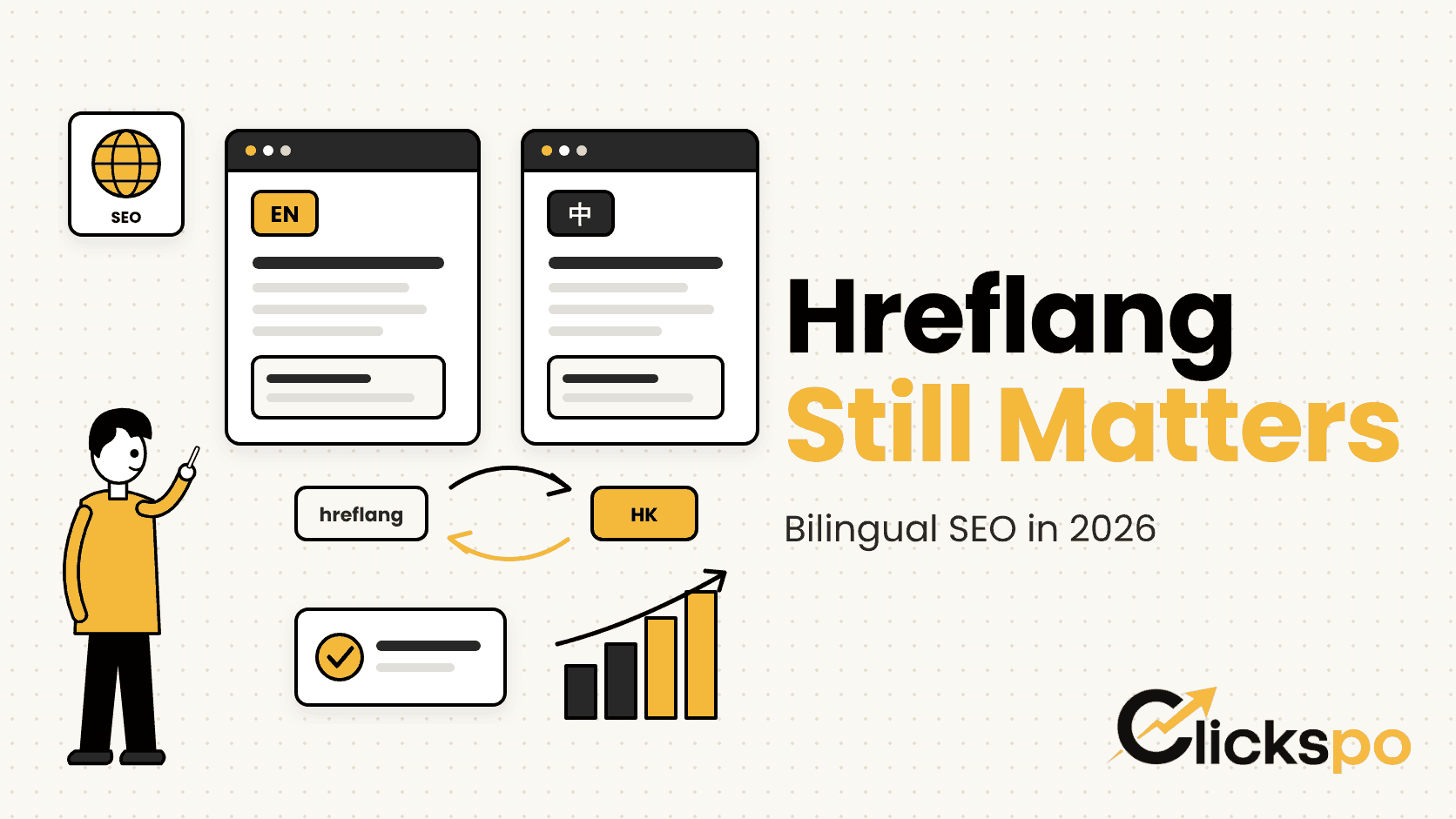
Most Hong Kong business websites speak two languages. A clinic, law firm or tutoring centre often runs an English version and a Traditional Chinese version side by side, and both versions compete for attention in the same city. That is the situation hreflang was built for. Yet in almost every audit our team runs on a bilingual site, we find hreflang tags that are missing, broken or contradicting each other. So is hreflang SEO still worth your attention in 2026, when Google has become good at reading language on its own? Our answer is yes, and here is why.
What Hreflang Is and Why It Exists
Hreflang is an HTML attribute that tells search engines a page has equivalent versions in other languages or for other regions. It sits in the page head, in the HTTP header, or in your XML sitemap, and it lists each alternate version alongside a language code. A Hong Kong page in Traditional Chinese, for example, would usually carry the code zh-HK, while its English partner would carry en-HK.
The purpose is simple. When someone in Hong Kong searches in Chinese, Google should show the Chinese page. When someone searches in English, Google should show the English page. Without hreflang, Google has to guess which version is the better match, and on bilingual sites that guess is not always the one you would choose. Interest in the topic remains steady. Ahrefs data for the US market shows “hreflang” at around 3,000 monthly searches, “hreflang tags” at 1,600 and “hreflang seo” at 1,400. Plenty of site owners and developers are still trying to get it right.
Is Hreflang Still Important for SEO in 2026?
Yes. Google’s documentation on localised versions of pages still recommends hreflang for sites with content in more than one language or for more than one region. Google has become very good at detecting the language of a page from its text, but detecting language and understanding relationships are two different jobs.
Hreflang does not make a page rank higher on its own. What it does is connect your translations into a set, so Google understands that your English service page and your Chinese service page are the same offer for different readers. That connection matters in three practical ways:
- The right version appears. Searchers see the page in the language they actually searched in, which keeps them on the page instead of clicking back.
- Translations stop competing. Without clear signals, two language versions can look like near duplicates, and Google may pick one and filter the other.
- The set is understood as one offer. Google treats the group as alternates of the same content rather than unrelated pages.
For Hong Kong businesses this is especially relevant. Many searches mix English and Chinese, many brand names are English even on Chinese pages, and Simplified Chinese content from other markets is competing for the same queries. Hreflang removes a layer of guesswork from all of that. It also feeds into how clearly AI search systems understand which page to cite for which audience, an area we cover in our AI SEO work.
How Hreflang Works: Return Tags and X Default
Two rules cause most of the confusion. Both are easy once you see them laid out.
Return Tags
Hreflang only works when it is confirmed in both directions. If your English page points to your Chinese page, the Chinese page must point back to the English page. Google calls these return links. When the return tag is missing, Google may ignore the annotation entirely, so a one sided setup is often no better than no setup at all.
Each page should also reference itself. A complete set on a bilingual site therefore looks like this on both pages:
- A tag pointing to the English version.
- A tag pointing to the Traditional Chinese version.
- A fallback tag for anyone who matches neither.
The X Default Fallback
The third line uses the special value x-default. It tells Google which page to show when a searcher’s language or region does not match any version you have listed. For most Hong Kong sites, the English homepage or a language selector page is the sensible choice. It is optional, but we add it on every project because it closes the gap for overseas visitors and for searchers using other languages.
Common Plugin Mistakes With WPML and Polylang
Most bilingual WordPress sites in Hong Kong use WPML or Polylang to manage translations. Both plugins output hreflang automatically, which is helpful, but automatic does not mean correct. These are the issues we find most often during a technical audit:
| Issue | What happens | How we fix it |
|---|---|---|
| Untranslated pages left unlinked | A Chinese page exists but was created as a separate post, so the plugin does not know it is a translation | Connect the two posts inside the plugin’s translation settings |
| Wrong language code in settings | The plugin outputs a generic Chinese code or a Simplified Chinese code for Traditional content | Set the correct language and Hong Kong region in the plugin’s language settings |
| Duplicate output from an SEO plugin | Two plugins print hreflang, sometimes with different values | Keep one source of truth and switch off the other output |
| Hidden or draft translations included | Tags point to pages that return errors or redirects | Only list live, indexable pages that return a normal response |
| Language folders changed after launch | Old URLs remain in tags and sitemaps | Update the structure, add redirects and recrawl |
None of these show up on the front end. Visitors see a perfectly working language switcher while Google receives mixed signals. That is why we check the rendered source and the sitemap rather than trusting the plugin dashboard. If you prefer us to handle this as part of a wider setup, our WordPress SEO service covers multilingual configuration from the start.
Hreflang vs Canonical: How They Work Together
Hreflang and the canonical tag are often confused, and mixing them up is one of the most damaging mistakes a bilingual site can make. A canonical tag says “this is the preferred version of this content, consolidate everything here”. Hreflang says “these are equal versions for different audiences, show the right one”.
The conflict appears when every language version carries a canonical pointing to the English page. That tells Google the Chinese page is just a copy, so Google may drop it from results, and the hreflang annotation is ignored because it points to a page you have just declared non canonical. The rule we follow is straightforward:
- Each language version has a self referencing canonical.
- Hreflang then links those canonical URLs together.
- Hreflang should never point to a URL that canonicalises somewhere else.
When we review a bilingual site where the Chinese pages seem to be missing from Google, this pairing is one of the first things we check.
How We Set Up and Check Hreflang
Our process is the same whether the site has twenty pages or two thousand. We start by mapping every English page to its Chinese partner in a spreadsheet, which immediately shows pages that have no translation or translations with no partner. From there we decide on the implementation method. For smaller sites, tags in the page head are easiest to maintain. For larger sites, listing alternates in the XML sitemap keeps the HTML lighter and is easier to audit in one place.
After launch we crawl the site, confirm every tag has a return partner, check that each URL returns a normal response, and review how each language version is indexed in Search Console. We also look at how the language versions link to each other in the body content, because clear internal linking between translations supports the same message hreflang is sending. Then we revisit the setup whenever new pages, new languages or a site migration are planned.
FAQs About Hreflang and SEO
Do I need hreflang if my site only has one language?
No. Hreflang is only useful when equivalent versions of a page exist in other languages or for other regions. A single language site gains nothing from adding it.
Should I use a Hong Kong region code or just a language code?
If your content is written for Hong Kong readers, adding the Hong Kong region is a sensible choice, especially for Traditional Chinese. Just remember that the language always comes first and the region is optional, never the other way round.
Does Bing use hreflang?
Bing has historically relied more on the content language meta tag and other signals than on hreflang. Keeping a clear language declaration in your HTML alongside hreflang covers both search engines.
How long does it take Google to pick up hreflang changes?
Google needs to recrawl every page in the set before the annotations are confirmed, so it depends on how often your pages are crawled. Submitting an updated sitemap helps Google find the changes sooner.
Can hreflang fix Simplified Chinese pages outranking my Traditional Chinese pages?
Only if both pages are on your own site. Hreflang works between pages you control, so it can point Hong Kong searchers to your Traditional version, but it has no influence over other websites.