
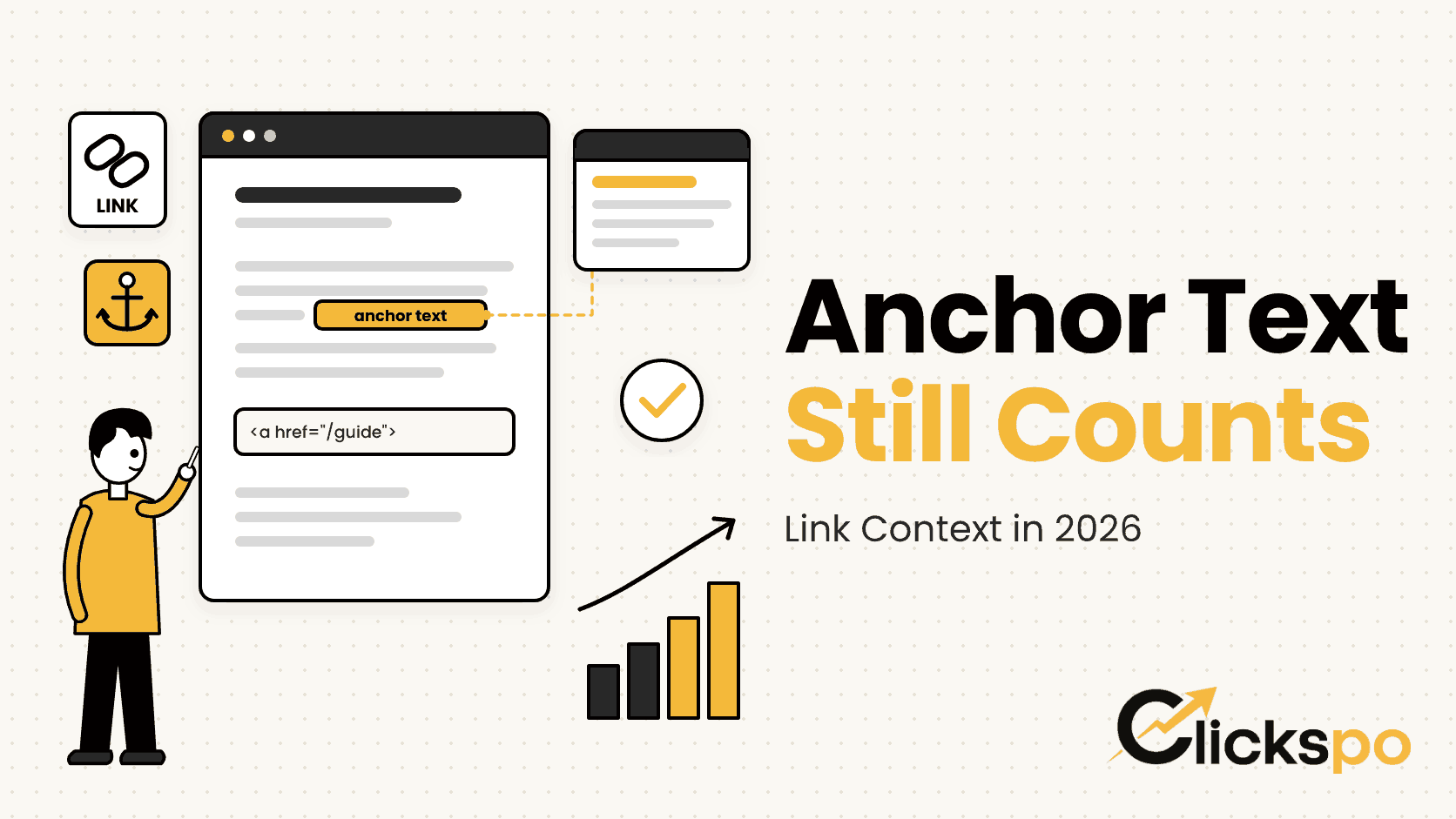
Anchor text is the clickable wording of a link, and it is easy to treat as an afterthought. Writers paste in a URL, type “click here” and move on. Yet every link on your site, and every link pointing to it from elsewhere, carries a small label that tells Google and your visitors what to expect on the other side. So is anchor text still important for SEO in 2026, now that search engines understand language far better than they once did? Our answer is yes, although the way it matters has shifted from keyword matching towards clear, honest context.
What Anchor Text Is and Why Search Engines Read It
Anchor text is the visible, clickable text inside a hyperlink. In HTML it sits between the opening and closing link tags, like this:
<a href="/dental/implants">dental implant costs in Hong Kong</a>
In that example, “dental implant costs in Hong Kong” is the anchor text. It does three jobs at once:
- It sets expectations for visitors. A reader scanning the page knows what they will get before they click.
- It gives search engines context. Google’s own link guidance recommends descriptive anchor text, because the words in a link help it understand what the destination page covers.
- It supports accessibility. Screen reader users often jump from link to link, so each anchor needs to make sense on its own.
Interest in the topic remains steady. Ahrefs data for the US market shows “anchor text” at 3,900 monthly searches, “what is anchor text” at 1,700 and “anchor text SEO” at 900. People are clearly still asking how it works, which tells us the question has not been settled for many site owners.
Does Anchor Text Still Matter for SEO in 2026?
Yes. Google has used link text as a relevance signal since its earliest days, and its current documentation still asks site owners to write anchor text that is descriptive, reasonably concise and relevant to the page it links to. What has changed is how intelligently the text is read.
Modern language models understand synonyms, surrounding sentences and intent. A link reading “how much implants cost” and one reading “implant pricing guide” point to the same idea, and Google can see that. This means anchor text no longer needs to repeat a keyword word for word to be useful. It needs to be accurate.
Internal Anchors vs External Anchors
Anchor text works in two places, and you control them very differently.
| Aspect | Internal anchor text | External anchor text |
|---|---|---|
| Where it appears | Links between pages on your own site | Links from other websites to yours |
| Who controls it | You, fully | The other site, mostly |
| Main purpose | Guiding visitors and showing site structure | Showing how others describe your page |
| Typical risk | Vague labels such as “read more” | An unnatural pattern of keyword heavy links |
| Best practice | Descriptive and varied wording | Earn links naturally and let wording vary |
Internal anchors are where most businesses can make real improvements today, because every link is under your control. We explain the wider structure in our guide to internal linking for SEO. External anchors come with the links other sites give you, which we cover in our article on whether backlinks still work.
The Main Anchor Text Types
SEO teams usually group anchors into a handful of anchor text types. Each has a place, and a healthy link profile contains a mix of them. Using a Central law firm page about divorce services as the destination, here is how each type looks:
- Exact match. The anchor is the target keyword itself, such as “divorce lawyer Hong Kong”. Useful in moderation, risky when overused.
- Partial match. The keyword appears with other words, such as “speak to our divorce lawyers in Central”. This reads naturally and still carries clear context.
- Branded. The anchor is the business name, such as the firm’s own name. This is how most people naturally link to a company.
- Generic. Phrases like “click here”, “learn more” or “this page”. They tell search engines and readers almost nothing.
- Naked URL. The address itself is the link, such as “clickspo.hk”. Common in directories, forums and citations.
- Image anchors. When an image is linked, its alt text acts as the anchor, which is one more reason we care about alt text.
No single type is right for every link. The aim is a pattern that looks like real people describing your pages in their own words, because that is exactly what a natural link profile is.
The Risk of Over Optimisation
Years ago, stuffing exact match anchors into every link was a common tactic. Google’s link spam systems were built to catch exactly this kind of manipulation, and its spam policies still list keyword rich anchor text in paid or arranged links as a link scheme.
Over optimisation tends to show up in a few recognisable ways:
- Most backlinks to one page using the identical commercial phrase.
- Footer or sidebar links across hundreds of pages carrying the same keyword.
- Guest posts or directory listings where the anchor was clearly chosen by the site owner, not the writer.
- Internal links that force a keyword into sentences where it does not belong.
Internal anchors carry far less risk than external ones, since linking between your own pages is normal and expected. Even so, a page where every link repeats “best SEO agency Hong Kong” reads badly to humans, and that matters. Our team treats variety as the safe default: describe the page honestly and the wording will vary on its own.
How to Write Natural, Descriptive Anchors
Good anchor text answers one question for the reader: what will I find if I click this? A few habits make that easy.
- Describe the destination, not the action. “Our guide to choosing an international school tutor” beats “click here for more”.
- Keep it short. Two to six words is usually enough. Linking a whole sentence dilutes the meaning.
- Match the destination’s intent. If the page is a pricing guide, the anchor should mention pricing. Understanding search intent helps here.
- Write the sentence first. Then choose the words inside it that best describe the linked page.
- Vary the wording. Ten links to the same page can each use a slightly different, accurate phrase.
- Avoid duplicate anchors for different pages. If “skincare treatments” links to two different URLs, search engines and readers get mixed signals.
Clear anchors also help AI search. Assistants such as ChatGPT, Perplexity and Google’s AI Overviews rely on understanding how pages connect and what each one covers. Descriptive links make that relationship easier to read, which supports the wider work we describe in our guide to AI search optimisation.
Reviewing Anchor Text on Your Site
Anchor text problems are rarely dramatic, but they add up across hundreds of pages. When we run a technical SEO audit, we review anchors in a set order. First we crawl the site and export every internal link with its anchor and destination. Next we filter for generic phrases such as “click here”, “here” and “read more”, which are usually the quickest fixes. Then we check the most important service and product pages to see how they are described across the site, and whether the wording matches what each page actually offers. Finally we look at the backlink profile for unusual concentrations of identical commercial anchors.
For a Hong Kong retail brand, that might mean replacing “shop now” links in blog posts with anchors naming the actual collection. For an education centre, it might mean linking course pages with the subject and level rather than “find out more”. These are small edits, but they make every link more useful for readers and for search engines.
FAQs About Anchor Text and SEO
Is “click here” bad for SEO?
It is not penalised, but it wastes an opportunity. A generic anchor gives search engines and screen reader users no information about the destination. Rewriting it to describe the linked page is almost always better.
How long should anchor text be?
There is no fixed limit, but most effective anchors are between two and six words. The anchor should be long enough to describe the destination and short enough to scan easily.
Can I use the same anchor text for multiple internal links?
You can use the same anchor for several links to one page without problems. The issue arises when one anchor points to several different pages, which blurs which page is the best match for that topic.
Should I ask other websites to use specific anchor text?
We advise against dictating keyword anchors to other sites. Links arranged with chosen commercial anchors can fall under Google’s link scheme policies. It is better to earn mentions and let the linking site describe you naturally.
Does anchor text matter for Chinese language pages?
Yes, the same principles apply. Use descriptive Chinese wording that matches how your audience searches and how the destination page is written, and keep anchors consistent with the language of the surrounding text.